Key takeaways
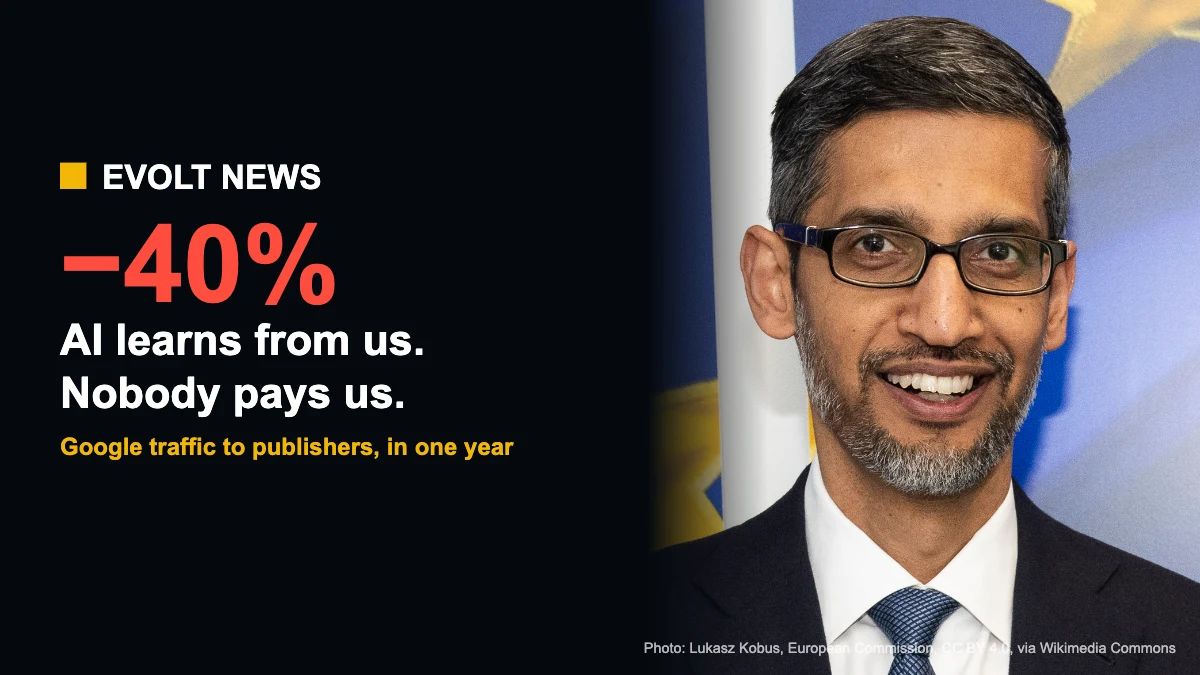
- Google search traffic to publishers fell 40% in one year, from July 2025 to July 2026, according to Chartbeat. Small sites lost about 60% over two years, and Google Discover dropped 34% in the last year.
- Google now tests paying some publishers when their content shapes AI answers. The pilot is invite-only, and small sites reportedly earned under $1,000 over several months.
- My view: the old deal between Google and the web is broken. AI learns from our work, nobody pays us for it, and without people who can live from writing, AI will only hear one side.
According to Chartbeat data, traffic from Google Search to news and media sites fell 40.2% between July 2025 and July 2026, after a 21.9% drop the year before. Small publishers were hit hardest, losing about 60% of their search traffic over two years, while Google Discover referrals fell 34.3% in the last year. AI chatbots such as ChatGPT and Gemini send publishers only a tiny fraction of their visits.
A Pew Research Center study found that people click a regular search result in about 8% of visits when Google shows an AI summary, compared with 15% without one, and click a link inside the summary only about 1% of the time. Since spring 2026, Google has been testing an invite-only “AI Contribution” pilot that pays some publishers when their content “contributes significantly” to answers in AI Overviews, AI Mode and Gemini. Reported payouts for small sites are under $1,000 over several months, and the European Commission has been investigating how Google uses publishers’ content for AI since December 2025.
In this article: The old deal is broken · “Better clicks”? Show me the data · Pocket change is not a fair deal · Why they will never switch it off · Who will write when nobody can live from it? · Paying for independence is for people with money · AI will only see one side · AI as a helper, not a replacement · FAQ
The old deal is broken
For 25 years, the deal was simple. We let Google read our articles for free, Google showed its ads and sent us readers, and we lived from the ads on our own sites. Everybody gave something, and everybody got something.
Now Google still reads everything for free, its AI writes the answer from our work, and the readers stay with Google. Minus 40% in one single year is not a drop. It is a collapse. And now imagine what comes next.
“Better clicks”? Show me the data
Google says people search more because of AI, and that the clicks from AI answers are “higher quality”. Fine. Where is the data? There is none. It is just a statement.
The independent numbers say the opposite: half the clicks when an AI summary appears, and almost nobody clicks the link inside it. On one side we have measurements from thousands of sites. On the other side, “trust us”.
Pocket change is not a fair deal
And now Google wants to pay publishers. Under $1,000 for several months, for a small site that lost a third of its readers. That does not even pay the rent. Who would want to work with Google like this?
In my opinion, it is an alibi for the courts and for the investigation in Europe, not a real payment. Only invited sites get it, the formula is secret, and the amount changes every month without explanation.
Why they will never switch it off
Why don’t they simply remove the AI summaries for news and leave it as it was? Because it is done on purpose. When people stay in Google and chat with Gemini, they see Google’s ads, not the ads on our sites. Google already puts ads into AI Mode, and OpenAI has started testing ads in ChatGPT.
The money that used to go to the people who write now stays with the giants. And no company will switch it off voluntarily, because users would just move to a competitor that keeps the summaries.
Governments tried to force the big platforms to pay for news before. In Canada, Meta answered by blocking news completely. These companies are stronger today than many countries.
Who will write when nobody can live from it?
This is the part almost no one mentions. Writing, filming and collecting facts is a full-time job. When it does not pay, people cannot do it, even if they want to. Some will still write after work, maybe one article a month. But you cannot watch companies and politicians every day like that.
And where will all these independent journalists go to work? There is no answer yet.
The same is coming to YouTube. When one button gives you a summary of a video, you don’t need to watch it. Fewer views, less money from ads, and one more independent voice that cannot afford to keep going.
Paying for independence is for people with money
They say readers will pay independent writers directly, on Substack and similar platforms. Maybe in the US, Canada or the UK. But people around the world already have 10 or 20 subscriptions, and they will not pay for one more.
So what are we talking about? Independent news only for people with money, and everyone else gets the free version from AI and the corporations. Before, the reader paid nothing. Google had fresh information, we had readers, and the ads paid for everything.
AI will only see one side
If independent sites disappear, what will AI learn from? From the big media companies that have licensing deals, from company press releases, and from a few big platforms. The big media are careful not to lose their big advertisers. The big tech sites live from their good relationships with the companies they write about. You rarely see a hard comparison there, or the simple truth that a new feature is almost useless.
Social networks will not save it either. A post is a short opinion, not facts and context. And if AI can summarize what people say on Reddit, why would anyone go to Reddit at all?
An AI answer should check the facts from many different sources, exactly like a person should. When independent sources disappear, there will be nothing to check against. That is the perfect space for corporations and politicians who want to decide what people think. The way I see it, a huge propaganda machine is being built right now, behind the friendly mask of AI.
AI as a helper, not a replacement
I am not against AI. AI is a great helper. But a helper, not a replacement for living people. Companies like Anthropic already hire fewer juniors because AI agents do the work, and everyone talks about productivity. Not a word about who will create the content AI learns from.
They learn from us, and nobody pays us for it. The companies that make billions from AI should pay the people they learn from. Until that happens, we will all pay for the most comfortable answer by losing the people who tell us the truth.
Also on Evolt News: ChatGPT wants my iCloud mail. No thanks · Apple vs OpenAI: a trial over a device nobody has seen
Photo: Sundar Pichai, CEO of Google, at the European Commission in 2023. Lukasz Kobus, European Commission, CC BY 4.0, via Wikimedia Commons.
This article is opinion.
Google AI and publishers: FAQ
How much has Google search traffic to publishers dropped?
According to Chartbeat, Google Search referrals to news and media sites fell 40.2% from July 2025 to July 2026. Small publishers lost about 60% of their search traffic over two years.
Why do AI Overviews reduce clicks?
The AI summary answers the question directly on Google. A Pew Research Center study found people click a search result in about 8% of visits with an AI summary, compared with 15% without one.
Does Google pay publishers for AI answers?
Google is testing an invite-only “AI Contribution” pilot that pays some publishers when their content contributes significantly to AI Overviews, AI Mode or Gemini answers. Google has not published how payouts are calculated, and small sites reportedly earned under $1,000 over several months.
Is Google Discover traffic also falling?
Yes. Chartbeat measured a 34.3% drop in Discover referrals in the year to July 2026, after a 6.6% drop the year before. Google is also testing AI summaries that combine several publishers in one Discover card.
Can publishers block Google from using their content in AI answers?
Not in a practical way today. Sites that want to appear in Google Search generally also appear as sources for AI Overviews and AI Mode, which is one reason publishers have sued Google and the European Commission is investigating.
Sources: Chartbeat, Pew Research Center, Axios, Digiday, Search Engine Roundtable, Search Engine Journal, Android Headlines, WebmasterWorld.
Our Take
Google built its business on our articles and paid us back with readers. Now its AI keeps the readers, and the payment is pocket change for a few invited sites.
If nobody can live from writing, AI will learn only from corporations, press releases and politicians. That is not progress. That is one voice talking to everyone.