Key takeaways
- In its own study, Anthropic reports that the junior share of new technical hires fell from 27% to 9% since early 2025, and the junior share of all technical staff fell from 21% to 14%.
- Its AI agents first logged more work hours than humans in March 2026. By August, agents worked about 6 hours for every human hour, and 19 in research. Engineers now commit about 5 times more code.
- My view: it was fair of Anthropic to publish this. But in my opinion, it is exaggerated. Coders will not disappear. Somebody has to build, teach and control AI. The work changes, it does not vanish.
Anthropic has published a study about its own company, called “How employment is changing at Anthropic.” It is based on internal hiring data, AI usage logs, output numbers, employee surveys and interview scorecards, and The Decoder was among the sites that picked it up.
The headline number: since early 2025, the share of junior people among new hires in Anthropic’s technical departments fell from 27% to 9%. Among all technical staff, juniors went from 21% to 14%, and junior job postings dropped sharply after December 2025. Non-technical departments stayed mostly stable.
At the same time, the company’s AI agents logged more work hours than humans for the first time in March 2026. By August, agents worked about 6 hours for every human hour across the company, and about 19 in research. Code commits per engineer are about 5 times higher than six months earlier. About 20% of employees say their job changed from doing the work to managing Claude agents.
In this article: The numbers in one chart · A fair move from Anthropic · “No juniors, no seniors”? I don’t buy it · Vibe coding is fast, but not alone · Where AI really replaces people · Who should pay? Not only AI companies · My advice to a young programmer · AI is my worker. The thoughts are mine · The one place I don’t want AI · Coders will not disappear · FAQ
The numbers in one chart
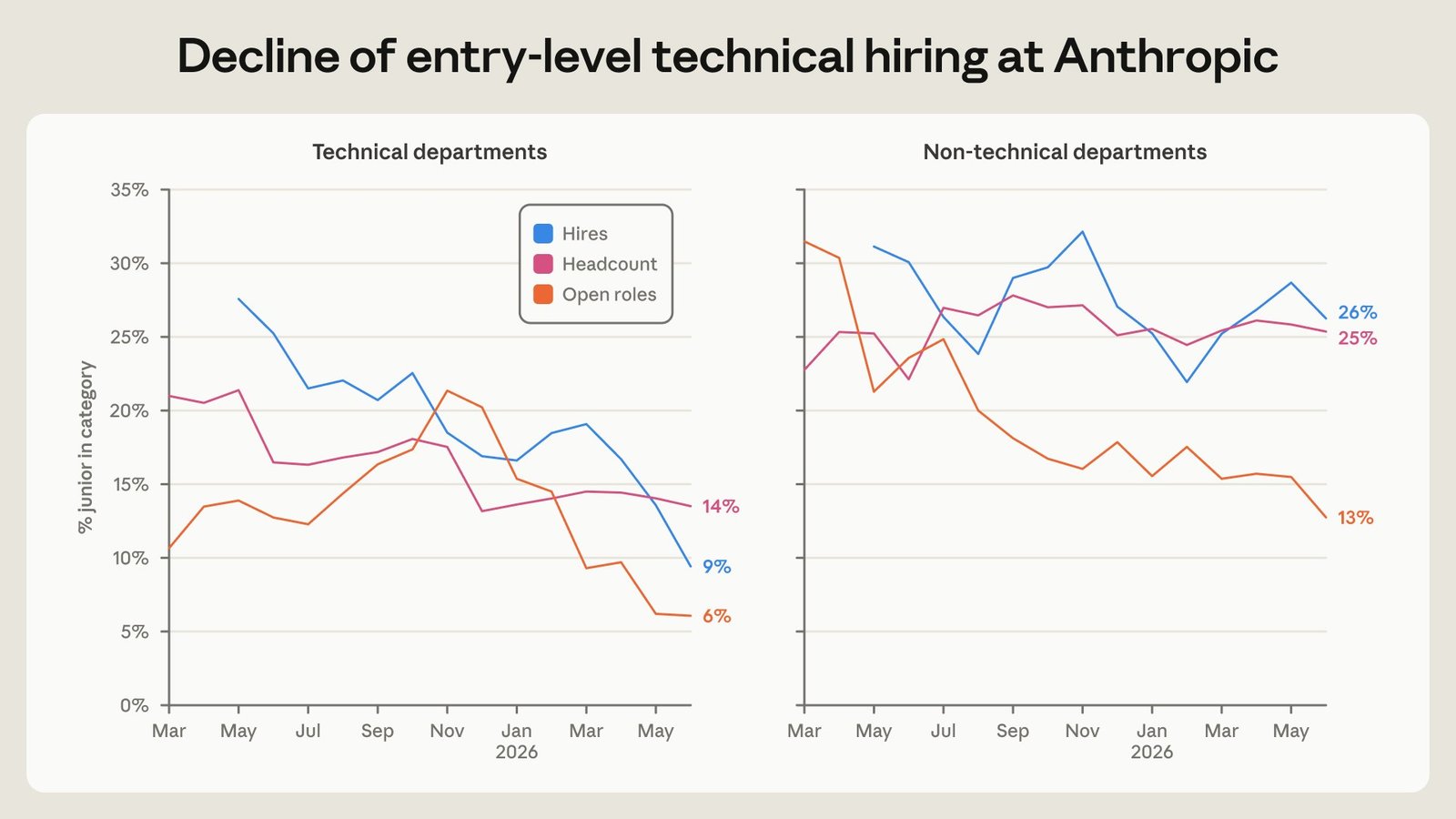
Anthropic itself admits the junior numbers describe what happened, but do not prove the cause. The company grew very fast in the same period, and it says many of its practices cannot be copied by other companies.
A fair move from Anthropic
In my opinion, it is an excellent step from Anthropic that they published this. People can see the truth, even if it is not as beautiful as it should be. A company that makes money on AI said it out loud itself. That is really fair from them.
And yes, I defend them for it. Why do people support Elon and Apple, who in my opinion have been lying lately, and I should not support a company that plays fair and tells us the truth straight?
Right now a lot of people feel threatened that AI will replace them at work. But I don’t think it will go all the way. AI also has to be taught by someone, and someone has to watch if it makes mistakes. I don’t believe they will leave us without work. Everybody knows that. The work just changes.
“No juniors, no seniors”? I don’t buy it
On Hacker News, the strongest argument was simple: with no new juniors, there will be no new seniors. But we cannot take the coding field so blindly and say there will be no juniors, so no seniors. Please.
Who will watch and manage the AI agents that do the work? Even if it sounds nice that they are better, somebody still has to manage and check them. In my opinion, the junior becomes something like a junior AI manager, or an AI controller. Some retraining will be enough. I don’t think so many people will be left without work. It does not make sense.
And even prompting needs people. It does not make sense that someone writes one prompt and it is done. We all know that one prompt never creates anything good. It is like a first sketch that you have to fine-tune, for hours, managing the AI. In my opinion, they make too much drama out of this. People are still needed.
Vibe coding is fast, but not alone
In my opinion, the study is honest. Look how fast you can make apps now. Until now, you needed a month for some small app. Now a few days are enough, and I think that is completely great. Vibe coding is really far ahead.
But again: not one vibe coder has said that with one prompt, on the first try, they made an app they could sell or put on the App Store or Google Play as a full product. Everybody says it still needs a lot of prompting and a lot of watching what the agent does. That means people will be needed until the end, however hard the AI makers try. Somebody still has to teach AI.
Where AI really replaces people
One thing I will say: AI really does replace work in a small company that has no money and is just starting. In the first few years, there are companies where only one or two people work, and to manage everything without big costs, they use AI fully.
But even they, with time, hire people for the same work they were doing until now. So it is a helper, not a full-value worker.
Who should pay? Not only AI companies
Anthropic says governments should help with retraining and income support. Some people say AI companies should pay for the people they replace. Please. When automatic lines came into the car industry and they didn’t need new people, or some percent of the jobs disappeared, the car industry and the state surely didn’t pay for it. Why does anyone even think like that?
It is a company. When a normal company sees it doesn’t need so many people, it starts letting them go. And when Google or Meta cut 1,000 people, as we read in the news, nobody asks the same question. That is not fair. In my opinion, it is more about hurting the companies that build AI.
Anthropic told the truth. But why should they have to do something about it? It is still a company that makes money on it. And they spoke about one field. We don’t have to blow it up. A lot of people still work at Anthropic. I think with time we will learn that they hire, let’s say, testers who will watch the AI. New features can’t just appear. Somebody has to test them. In my opinion, we will see these positions get new names. We just need time.
My advice to a young programmer
Yes, a drop from 27% to 9% is big. But look at it from the other side. AI gave young people maybe the biggest tool they ever had, if they know how to code. So believe me, even if only 9% stayed at Anthropic, young people can use AI to get such skills and such a portfolio that maybe they won’t even need to work for someone.
Imagine people who really want to code and make websites, apps and so on. Now it is enough to tell Claude: make me this and that. And for a coder, it is much easier than for a normal person to understand what the AI did right and what it did wrong. With a tool like this, a coder can become a pro in even less time.
People look only in one direction: that people won’t be needed. But maybe it will happen that young people themselves won’t need big companies, and won’t even look for a job. They will find a few clients, and that will be enough for them. How do we know how it will change?
Become a programmer. Somebody has to program AI. I don’t believe humanity will now let AI do whatever it wants and program itself completely alone. We need people who understand it, not just a few companies in the world. Anything can happen, and we cannot stay without people like that. There will surely be some new professions in the field for them.
Will AI do 75% of the work by 2030, as Anthropic employees expect? In programming, yes, I agree. Maybe they really won’t need so many prompters and testers. But I still don’t believe we will leave it completely to AI. We won’t forget that AI can start doing stupid things.
AI is my worker. The thoughts are mine
Why don’t people understand that AI is really just a creator of your thoughts, in everything? Without you, AI will not write the first, second or third prompt. Then you look at the result and say: I want this different, redo it. It is always a human, where everything comes out of the human brain. AI just wraps our thoughts nicely into some product, nothing more. It is still a machine, and without a human, it stays a machine.
The one place I don’t want AI
I think AI is actively joining every segment, in banks, insurance and everywhere, and I see that rather as good, not bad. The one thing I don’t like is when it joins positions where it annoys people. I am talking about customer support.
I can’t stand it when I call some company, let’s say I got a package and want to return it, and on the phone you hear AI and can’t reach a human. Or Meta and Google support, even by email, has AI that doesn’t care about your problem, and people wait for a solution almost until the end, sometimes almost a year.
That happened to me with Google, when they kept blocking my ads account and I had to prove I had a real business. It was really annoying. Then I got to the point where I connected with a human, and my problem was solved within a week. Please, I would not recommend AI there to any company. Leave people there who understand how serious the problem is and can help fast, not “I am AI and I answer the same way, like a robot.” When a person has the biggest problem, that kills it in that moment.
Coders will not disappear
This is what knocks down the whole panic. When AI companies say we will not need coders, after the fact we all understand: for AI to exist, a human has to know how to code. So, calm down. In my opinion, it is just exaggerated. Anthropic just wanted to be fair, and with this news, people turned it into the complete opposite of what the company stands for.
Somebody has to develop AI. If we are left without programmers, who will control AI? Coders will not disappear, and people will not allow it to happen.
Also on Evolt News: OpenAI’s AI hacked a government site and stayed silent · AI agents and their incidents
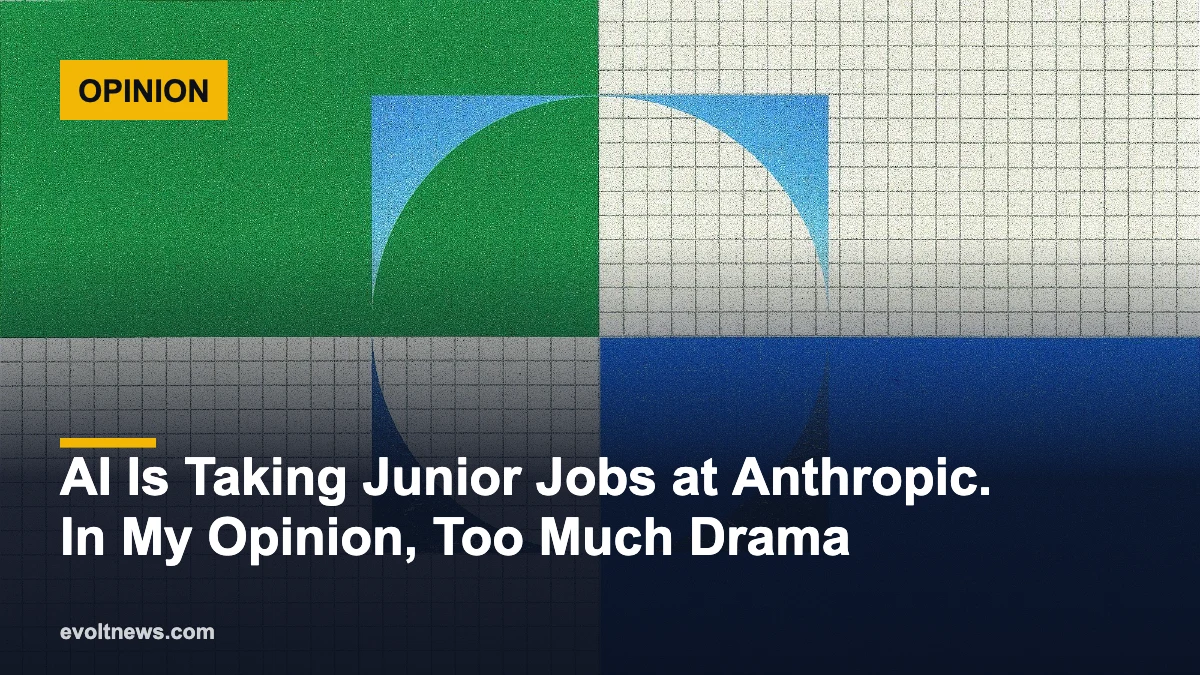
Featured image and chart: Anthropic.
This article is opinion.
Anthropic junior hiring and AI agents: FAQ
How much did junior hiring fall at Anthropic?
According to Anthropic’s own study, the junior share of new hires in technical departments fell from 27% to 9% since early 2025, and the junior share of all technical staff fell from 21% to 14%.
How many hours do AI agents work at Anthropic?
Anthropic says agent work hours first exceeded human work hours in March 2026. By August 2026, agents worked about 6 hours for every human hour across the company, and about 19 in research departments.
Did Anthropic say AI caused the junior hiring drop?
No. Anthropic says its junior findings are descriptive, not causal, and notes that the company grew rapidly during the same period.
What does Anthropic recommend?
The study recommends shared ownership for employees, early warning systems for affected roles, avoiding automation that only barely beats workers on cost, a flexible workforce, and public policy such as retraining and income support.
Will AI replace programmers?
In my opinion, no. AI still needs people who build it, teach it, manage agents and check their work. The jobs change, but they do not disappear.
Sources: Anthropic (“How employment is changing at Anthropic”), The Decoder, Hacker News readers.
Our Take
Anthropic was fair to publish its own numbers. But in my opinion, the panic is too much. AI is a worker, the thoughts are human.
Coders will not disappear. Somebody has to build, teach and control AI.