Key takeaways
- Apple’s new insider trading policy bans employees, contractors and even family members from betting on prediction markets with Apple’s confidential information.
- The ban covers information about suppliers, manufacturers and carriers too, and applies even when the bet would be legal.
- My view: Apple guards its secrets from its own people better than it shares the truth with its customers. And I bet they didn’t write this rule for nothing.
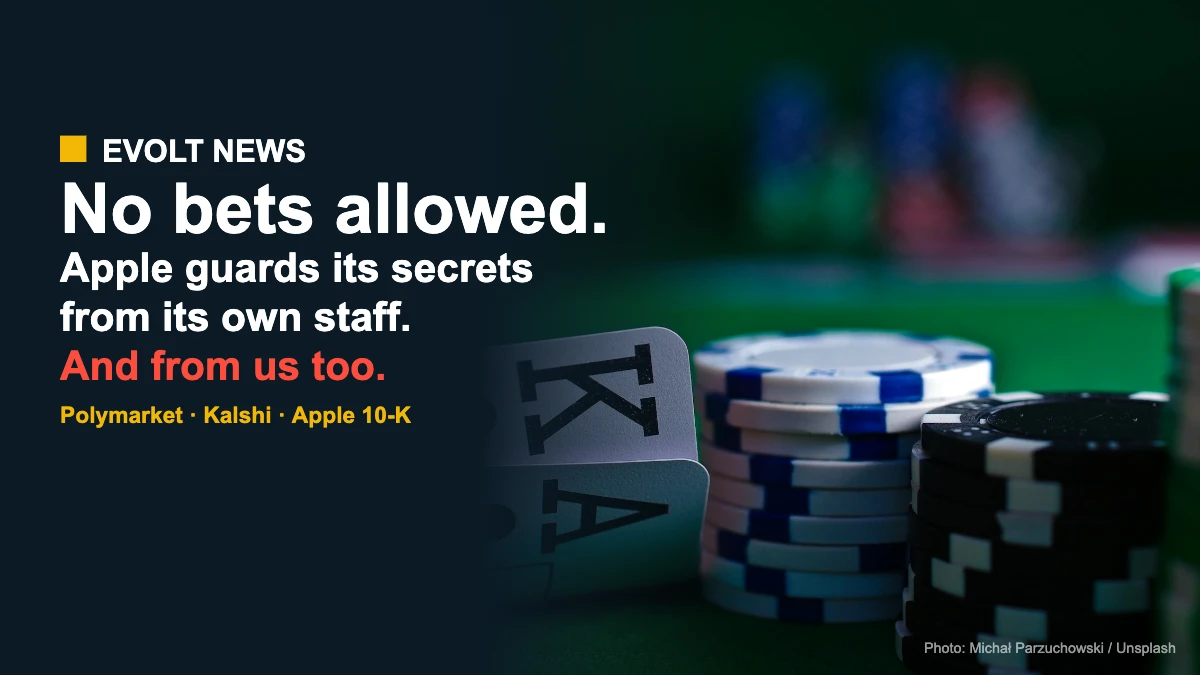
Apple now bans its employees, contractors and even their families from betting on prediction markets like Polymarket and Kalshi with Apple’s confidential information. The rule is in the policy Apple filed with its annual report on November 3, and it applies even when the bet would be legal.
In this article: Why now, Apple? · Look how well Apple protects its own secrets · Betting on a phone launch? Good grief · Credit where it’s due · My prediction · FAQ
Why now, Apple?
Nobody writes a rule like this for fun. A company like Apple doesn’t add a new paragraph to an official SEC filing because it’s bored. Something happened. Somebody bet on something they knew from the inside, or Apple caught somebody close to it. I’m 100% sure of it.
Imagine you work in a logistics warehouse. There are five of you, and nobody ever signed anything saying you are responsible when something goes missing. Then the owner lets three workers go. Maybe nothing even disappeared, but he felt some kind of threat. So what does he do with the two who stayed? He hands them a contract: if anything goes missing, you pay twice its value. A company doesn’t do things like that just because. Nobody does it without a reason.
And Apple says nothing. No case, no number, no explanation. Again. Same story as with the deepfake apps, the iPhone Duo cracks, the spyware warning. We learn everything from a filing that somebody had to dig out.
Look how well Apple protects its own secrets
Now look at the difference. When it comes to Apple’s secrets, Apple is a fortress. Employees, contractors, consultants, even their families. Even when the bet is legal, it’s forbidden. They thought of everything.
But when we ask how many iPhone Duo screens cracked, the answer is “a small number.” When 400 deepfake apps sat in the App Store for a year, no list, nothing. So Apple knows exactly how to control information. It just controls it in one direction: away from us.
If your secrets are worth so much that people could bet money on them, Apple, then maybe tell your customers at least half of what you know.
Betting on a phone launch? Good grief
And the world has gone crazy anyway. People bet on what Apple will name its next iPhone, on the date of an event, on whether something launches this year. A MrBeast employee paid a $20,000 fine on Kalshi for betting on what he knew about a YouTube stream. A man who ran Trump’s teleprompter allegedly won more than $100,000 because he knew the speeches in advance.
This is not investing. This is a casino where the people inside see your cards. And of course the ones who lose are ordinary people who bet without knowing anything.
Credit where it’s due
I’ll say it clearly: the rule itself is good. It’s right that Apple closes the door before an engineer bets his salary on the name of the next iPhone. And it’s right that it also covers suppliers and carriers, because that’s exactly where the leaks come from.
But a good rule without enforcement is paper. Prediction markets are full of anonymous wallets. How will Apple know that the account “duo_lover_88” is a guy from its supply chain? It won’t. In my opinion, this rule exists mostly so that Apple has something to point at when the next scandal hits.
My prediction
Within a year, we’ll read about the first Apple-related bet that looks too lucky to be luck. A product name, a launch date, a delay. And Apple will say again that it was “a small number of people.”
Apple, you can forbid your people to bet on your secrets. Fine. Now try something new: tell us the truth before others bet on it.
Also on Evolt News: 400 deepfake apps in the App Store · iPhone Duo memo: Apple’s quiet admission · Apple’s spyware warning in 99 countries
Featured image: Michał Parzuchowski / Unsplash.
This article is opinion.
Apple prediction market ban: FAQ
What did Apple ban?
Apple’s updated insider trading policy bans covered people from betting, trading or entering event contracts on prediction markets when the activity uses Apple Confidential Information, and from tipping that information to others.
Who does the rule cover?
Directors, officers, employees, independent contractors, consultants, certain family members, and entities they direct or influence.
Does it apply only to information about Apple?
No. It also covers confidential information about other companies that employees learn through their work at Apple, such as suppliers, manufacturers, vendors and carriers.
Does the ban apply if the bet is legal?
Yes. Apple says the prohibition applies whether or not the activity counts as insider trading or securities trading under the law.
When did Apple add the rule?
The rule appears in the policy marked “Updated October 2026,” filed with Apple’s fiscal 2026 Form 10-K on November 3, 2026. The 2024 version did not mention prediction markets.
What are prediction markets?
Platforms such as Polymarket and Kalshi where people buy and sell contracts on the outcome of future events, from elections to product launches.
I read this news on 9to5Mac.
Sources: Apple (Form 10-K), Fortune, RG.org.
Our Take
Apple’s new rule bans employees, contractors and their families from betting on prediction markets with confidential information, even when the bet would be legal. The rule is right, but Apple, as usual, didn’t say why it needed it now.
In my view, a company that guards its secrets this carefully could at least tell its customers the truth about cracked phones and dangerous apps.