Key takeaways
- Tesla registered a new German company, Tesla Machining Technologies Management SE, at the headquarters of struggling machine maker EMAG in Salach near Stuttgart.
- EMAG makes the machines for gears inside humanoid robots, lost €42 million in 2024, and local press reports about 220 of its workers could move to Tesla. Neither company confirmed anything.
- My view: Musk himself called the robot’s hardware the main problem. Now Tesla quietly shops for a German gear expert under a shell name. That says more about Optimus than any demo on stage.
Tesla registered a new company, Tesla Machining Technologies Management SE, whose address is the headquarters of German machine-tool maker EMAG in Salach near Stuttgart; it began in August as a shell called “Blitz 26-299 SE” and was renamed in November. EMAG, which makes gear-cutting machines also used for humanoid robot parts, lost €42 million on €496 million of revenue in 2024, and local press reports that about 220 of its employees could move to Tesla, while neither company has confirmed a deal.
In this article: A company called “Blitz”, hidden at someone else’s address · Musk said it himself: the problem is the hardware · Good news for 220 workers, if it is true · Why Germany, and why now? · My prediction · FAQ
A company called “Blitz”, hidden at someone else’s address
| What we know | Detail |
|---|---|
| New company | Tesla Machining Technologies Management SE |
| Address | EMAG headquarters, Salach near Stuttgart |
| Registered | August 26 as shell “Blitz 26-299 SE”, renamed in November |
| EMAG in 2024 | €42 million loss on €496 million revenue |
| EMAG job cuts | 455 announced in Germany, about 300 in Salach |
| Reported transfer | about 220 EMAG workers to Tesla (unconfirmed) |
| Official statement | none from Tesla or EMAG |
Look at how it was done. A ready-made shell company with the name “Blitz 26-299 SE”, bought in August, renamed in November, sitting at the address of another firm. No press release, no post on X. Tesla, a company that announces every small promise loudly, suddenly goes completely quiet. As always, we learn only what we are supposed to know, and the rest we have to search for ourselves in the German business register.
Musk said it himself: the problem is the hardware
On the Q3 earnings call, Musk called Optimus’ hardware its main problem and named custom gears as a reliability worry. That’s the funny part. For years we heard about a robot that will do our dishes and walk our dogs, and now we find out it still struggles with gears, the most basic mechanical thing.
So Tesla goes where the gears are: a German company with decades of experience in exactly these machines. In my view, it’s a smart move, and honestly the most normal thing Tesla has done with Optimus in a long time. You don’t build a robot with slides on a stage. You build it with people who know how to cut a gear.
Good news for 220 workers, if it is true
Let’s be fair. EMAG lost €42 million in one year and announced 455 job cuts in Germany, about 300 of them right there in Salach. If Tesla really takes around 220 of those people, that is a lifeline for families in a small town, and I am glad for them.
But nobody confirmed it. Not Tesla, not EMAG. And I have learned not to believe anything connected to Elon Musk until I see it with my own eyes. Remember Grünheide: big promises about jobs, and later we heard about cuts and pressure on workers. I hope the people in Salach get a better story.
Why Germany, and why now?
Tesla is installing a line in Fremont that is supposed to make a million robots a year. A million. And it doesn’t even have reliable gears yet. That is the whole Tesla method: first the giant number for investors, then the search for someone who can actually build it.
And the timing is no accident. Tesla is racing to finish the SpaceX merger, the EU vote on FSD was pushed to December 15, as I wrote in this article, and investors need a new story. “Tesla buys German robot engineering” sounds much better than “our robot still has a gear problem”.
My prediction
Within a few months we will see an Optimus presentation with the words “German engineering” somewhere on the slide, and Tesla fans will call it a revolution. I am almost 99% sure. Whether a single Optimus will really work in your home in 2027, that is a different question, and my answer is the same as for Cybercab: I don’t believe it until I see it. Tesla remains, for me, a factory of promises. This time, at least, it hired people who make real things.
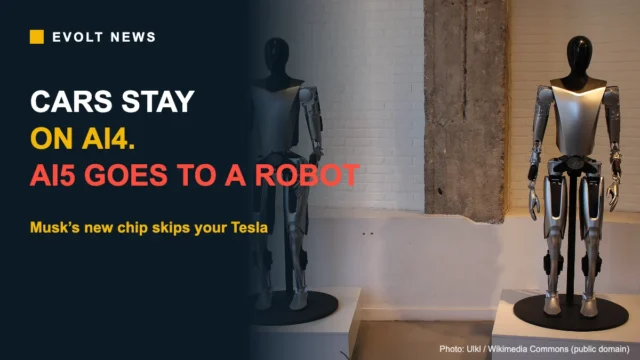
Also on Evolt News: AI5 goes to Optimus, your Tesla stays on AI4 · Tesla Q3: a factory of promises · The EU FSD vote moved to December 15
Featured image: Sikander / Wikimedia Commons (CC BY-SA 4.0).
This article is opinion.
Tesla and EMAG: FAQ
What is Tesla Machining Technologies Management SE?
It is a new German company registered by Tesla at the Munich district court. Its business address is the headquarters of machine maker EMAG in Salach, near Stuttgart.
What does EMAG make?
EMAG makes turning, grinding and gear-cutting machines, mostly for car parts like transmissions, and it also markets machines for humanoid robot parts such as flexsplines, wave generators and planetary gears.
Is Tesla buying EMAG?
Not confirmed. Neither Tesla nor EMAG has confirmed a deal or answered requests for comment. Local press reported that about 220 EMAG employees could move to Tesla.
Why does Tesla need gear makers?
Each Optimus robot uses many actuators with precise gears. On the Q3 earnings call, Elon Musk called Optimus hardware the main problem and named custom gears as a reliability concern.
How is EMAG doing financially?
EMAG lost €42 million on €496 million of revenue in 2024 and announced 455 job cuts in Germany, about 300 of them in Salach.
How many Optimus robots does Tesla plan to build?
Tesla is installing a line in Fremont designed for one million robots a year.
Sources: Electrek, Business Insider Germany, Stuttgarter Nachrichten.
Our Take
Tesla quietly registered a machining company at EMAG’s headquarters, a German gear-machine specialist, while Musk admits gears are Optimus’ weak point.
To me, hiring real engineers is the first honest step Tesla has taken with Optimus, but until a robot works in a real home, it is still a promise, not a product.