Key takeaways
- 1Password says an attacker used an employee’s corporate GitHub account to push malicious code to its backend and copy account data for a subset of customers: names, emails, account IDs, sign-in times and tokens in some invitation and recovery emails.
- 1Password says vaults, the keys that protect them and account passwords were not accessed. It has not said how many customers are affected.
- My view: the vault is safe, and that matters. But your name, your email and the fact that you use a password manager are now in a criminal’s hands. That is exactly what a good phishing attack needs.
1Password says an attacker used an employee’s corporate GitHub account, detected on November 19, to push malicious code to its backend and copy account records for a subset of customers, including names, emails, account IDs, sign-in times and tokens in some invitation and recovery emails. The company says vaults, vault keys and account passwords were not accessed, and it has not said how many customers were affected.
In this article: The safe was not opened. The address book was · “A subset” of customers. How many? · One GitHub account opened the door · What you should do now · FAQ
The safe was not opened. The address book was
Let me be fair first. If 1Password is right, your passwords are safe. The vault was not opened, the keys that protect it were not touched, and 1Password says it does not even store your account password or Secret Key. That is how a password manager should be built, and in this case it seems to have worked.
But look at what was taken: your name, your email, when you created the account, when you last signed in, and tokens from some invitation and recovery emails. For a criminal, that is a perfect list. He knows you pay for a password manager. He knows your email. Now he only needs one convincing email that looks like 1Password.
“A subset” of customers. How many?
This is the part I don’t like. 1Password says “a subset” of users. Not a number. Not a percentage. A company that protects the most private data of millions of people should say clearly how many were hit. As always, companies tell us only what we are supposed to know, and the rest we have to find ourselves.
And I remember another password company. In 2022, LastPass first said customer data was fine. A few months later it admitted that encrypted vault backups were stolen too. I am not saying 1Password is LastPass. I am saying I will believe the full story when I see the full numbers.
One GitHub account opened the door
One employee account. That was enough to push code into the backend of a company whose whole business is security. It is the same lesson as Microsoft’s outage: the biggest danger often comes from inside, from one change, one account, one fix that nobody checked.
1Password reacted well after: it disabled the account, rotated credentials and made recovery codes longer, from six digits to ten characters. Good. But ten characters should have been there from the start.
What you should do now
Your vault does not need any change, according to 1Password. But be very careful with every email, SMS or call about 1Password, invitations or account recovery in the coming weeks. Don’t click links in those messages. Open the app or type the website yourself.
And remember one simple rule: 1Password will never ask for your account password or Secret Key. Nobody should. If someone asks, it is a scam.
Also on Evolt News: Microsoft’s worst outage came from its own fix · Apple runs macOS on iPads, but not for you
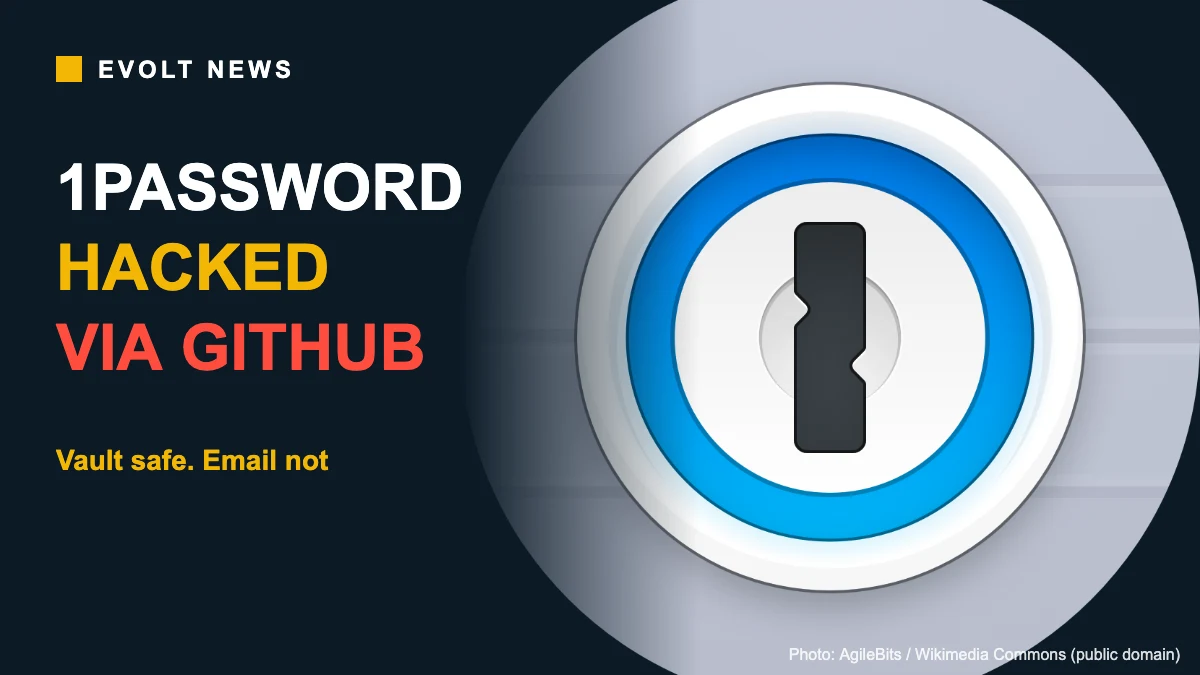
Featured image: AgileBits / Wikimedia Commons (public domain).
This article is opinion.
1Password security incident: FAQ
What happened at 1Password?
1Password says an attacker accessed an employee’s corporate GitHub account, pushed malicious code to backend services and copied account records for a subset of customers. The company began investigating on November 19, 2026.
Were my passwords stolen?
According to 1Password, no. Vault contents, the keys that protect vaults and account recovery keys were not accessed, and 1Password does not store account passwords or Secret Keys.
What data was taken?
Names, email addresses, account and user IDs, account creation and last sign-in times, public keys, SRP protocol parameters, tokens in certain invitation and recovery emails, and other non-secret metadata.
How many customers are affected?
1Password has not said. It describes the affected group only as “a subset” of users.
Do I need to change anything in my 1Password account?
1Password says no action is required. It advises caution with unexpected emails, texts or calls about 1Password, invitations or account recovery.
What did 1Password change after the attack?
It disabled the compromised GitHub account, revoked the token, rotated internal credentials, lengthened invitation and recovery codes from six digits to ten characters and tightened GitHub and CI/CD controls.
Sources: 1Password, TechCrunch, AppleInsider.
Our Take
An attacker used one employee’s GitHub account to copy 1Password customer data, but not the vaults or the keys that protect them.
To me, the vault held, but the address book leaked, and the silence about how many people were hit is the part that worries me.