Key takeaways
- Security researcher Jeremiah Fowler found an open database with about two billion login credentials, with no password and no encryption.
- About 400,000 documents were sorted into one folder per victim: cookies, browser data, files, clipboard and passwords, collected by advanced malware.
- My view: a strong password alone is not enough anymore. If malware copies your cookies, the attacker walks in through an open door. Here is what to do in ten minutes.
Security researcher Jeremiah Fowler found a publicly exposed database with about two billion login credentials that was neither password-protected nor encrypted. Around 400,000 documents came from malware that built a separate folder for each victim, which Fowler described with the words “if you had that, you own that person.”
In this article: This is not a leak. It is a copy of your life · A strong password is not enough · What to do, in ten minutes · FAQ
This is not a leak. It is a copy of your life
Two billion usernames, passwords and the addresses where they work. Inside were also thousands of logins for dark web sites, which Fowler says he had never seen in a leak like this. But the number is not the scariest part.
The scariest part is the folders. One folder per victim, with cookies, browser data, important files, system details, clipboard and passwords. Someone with that does not need to guess your password. Your cookies let them open your accounts as if they were you. That is not a leak anymore. That is a copy of your digital life.
A strong password is not enough
I keep saying it and I will say it again: you can have the longest password in the world, and if malware sits on your computer and copies your browser cookies, your password does not matter. The real protection starts earlier. Don’t install cracked software. Don’t open attachments you did not expect. Keep your system updated.
And the worst part: nobody knows who downloaded this database before it was removed. Fowler reported it and the host took it down, but how many people copied it before that, nobody can say.
What to do, in ten minutes
First, open the Passwords app on your iPhone or Mac. It shows which passwords appeared in leaks and which ones you reuse. Change those first. Second, turn on two-factor authentication everywhere, and choose an authenticator app over SMS, because a text message can be stolen with a swapped SIM card. Third, use passkeys wherever a site offers them. A passkey cannot leak like this, because there is no password to steal.
Also on Evolt News: Meta Muse: delete it · Banks block AI agents
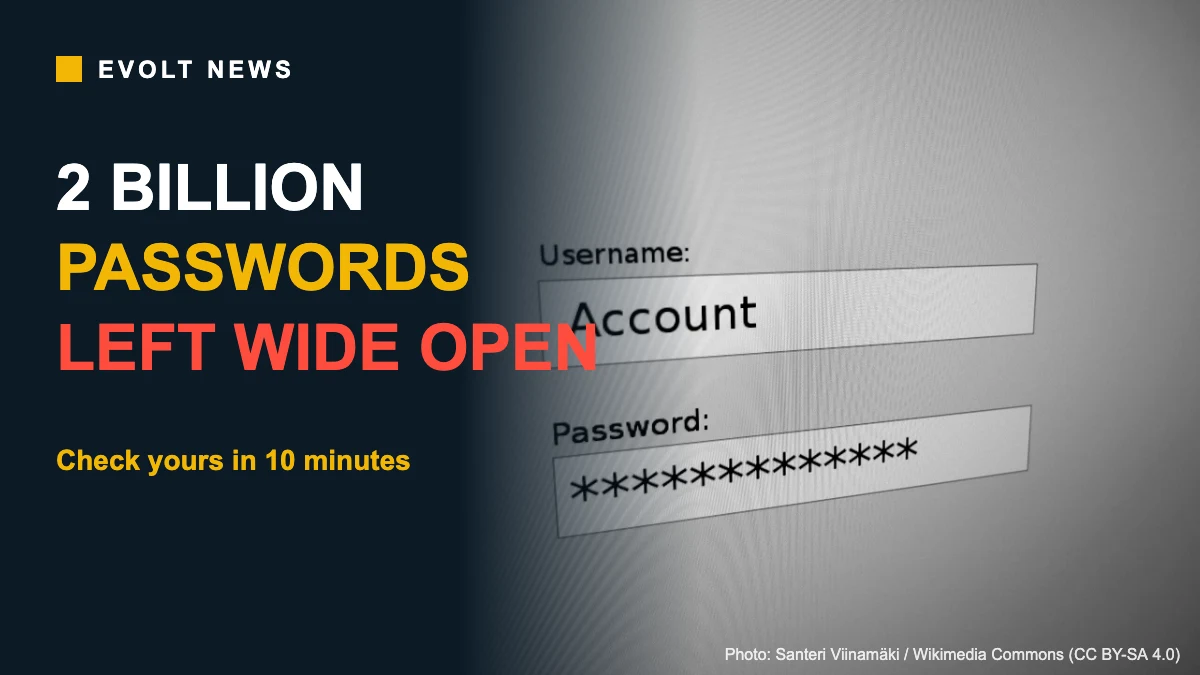
Featured image: Santeri Viinamäki / Wikimedia Commons (CC BY-SA 4.0).
This article is opinion.
Two billion leaked credentials: FAQ
Who found the two billion credentials?
Security researcher Jeremiah Fowler found the publicly exposed database, which had no password and no encryption.
What was in the database?
About two billion usernames, passwords and login addresses, thousands of dark web logins, and around 400,000 documents sorted into one folder per victim with cookies, browser data, files, clipboard and passwords.
Is the database still online?
Fowler reported it and the hosting company removed it. It is not known how many people accessed it before.
How do I check if my passwords leaked?
On iPhone or Mac, open the Passwords app and check the security recommendations for leaked and reused passwords. Change those, turn on two-factor authentication and use passkeys where possible.
Sources: Wired, Jeremiah Fowler, 9to5Mac.
Our Take
An open database exposed about two billion credentials and 400,000 per-victim malware folders, with no password and no encryption.
To me the lesson is simple: passwords alone are dead. Check the Passwords app, use an authenticator app and switch to passkeys.