Key takeaways
- Microsoft declared an internal Code Red after a nearly 24-hour outage on November 12 and 13 took down Exchange Online, Outlook, Teams and Copilot. More than 80% of the servers behind it stopped responding at the worst point.
- The cause was Microsoft’s own fix from July. Engineers fought it across 11 Teams chats with more than 11,000 messages, and the broken component had seen “roughly ten years’ worth of acceptable failures.”
- My view: the answer Microsoft gives is speed and AI agents. To me, the problem was never speed. It was a company so big that nobody saw the whole picture.
Microsoft declared an internal Code Red after a nearly 24-hour outage on November 12 and 13 knocked out Exchange Online, Outlook, Teams and Copilot, with more than 80% of the servers behind the service unresponsive at the worst point. The cause was a defect from a July fix to Microsoft 365 gateway servers, and Microsoft now wants any incident like it fixed in under an hour.
In this article: A July fix broke November · “Ten years of acceptable failures” · The answer: faster, and more AI · What it means for you · FAQ
Update: Another inside door, another breach: 1Password was hacked through one GitHub account.
A July fix broke November
This was not hackers and not AI agents, Microsoft says. It was its own fix from July, sitting on the servers for four months like a time bomb. Under heavy load, an internal Windows process locked itself up and ate all the processor and memory. Governments in Australia, Japan and the US lost email. Trading firms were delayed. Airlines had broken communication.
And this is the company that sells “enterprise reliability” to the whole world. If a small startup did this, it would be dead. Microsoft gets an apology from Satya Nadella and a new internal color code.
“Ten years of acceptable failures”
This sentence from Microsoft’s own Copilot boss says everything for me: the component had “roughly ten years’ worth of acceptable failures.” Acceptable for whom? For Microsoft it is a statistic. For a small business that couldn’t send an invoice for a whole day, it is lost money.
And now the part that is almost a black joke. While email was down, the engineers tried to understand the problem in 11 Teams chats with more than 11,000 messages, because the data they needed was scattered across fragmented internal systems. One of their own memos calls it a “fog of war.” A company with thousands of engineers, and nobody saw the whole picture.
The answer: faster, and more AI
Microsoft’s plan is to fix any future incident like this in under an hour, with AI agents helping engineers read the system data. In the same breath it says AI agents were not the cause, and promises AI agents as the cure. Wow.
One security expert said it perfectly: a pipeline that can push a fix in an hour can push a mistake in an hour. The July fix was exactly that, a change that went everywhere. In my opinion, Microsoft doesn’t need to be faster. It needs to test before it pushes, and to understand its own systems before it hands them to an AI.
What it means for you
When one company holds your email, your calendar, your files and now your AI assistant, one bad fix can stop your whole day. That is true for Microsoft, and it is true for Google and Apple’s iCloud too.
So keep a second way to reach the people who matter, like a phone number or another email address. Export what you can’t lose. And don’t believe that “too big to fail” means “too big to break.” This outage just proved the opposite.
Also on Evolt News: Microsoft To Do is retiring · Meta Muse and the risk of AI agents
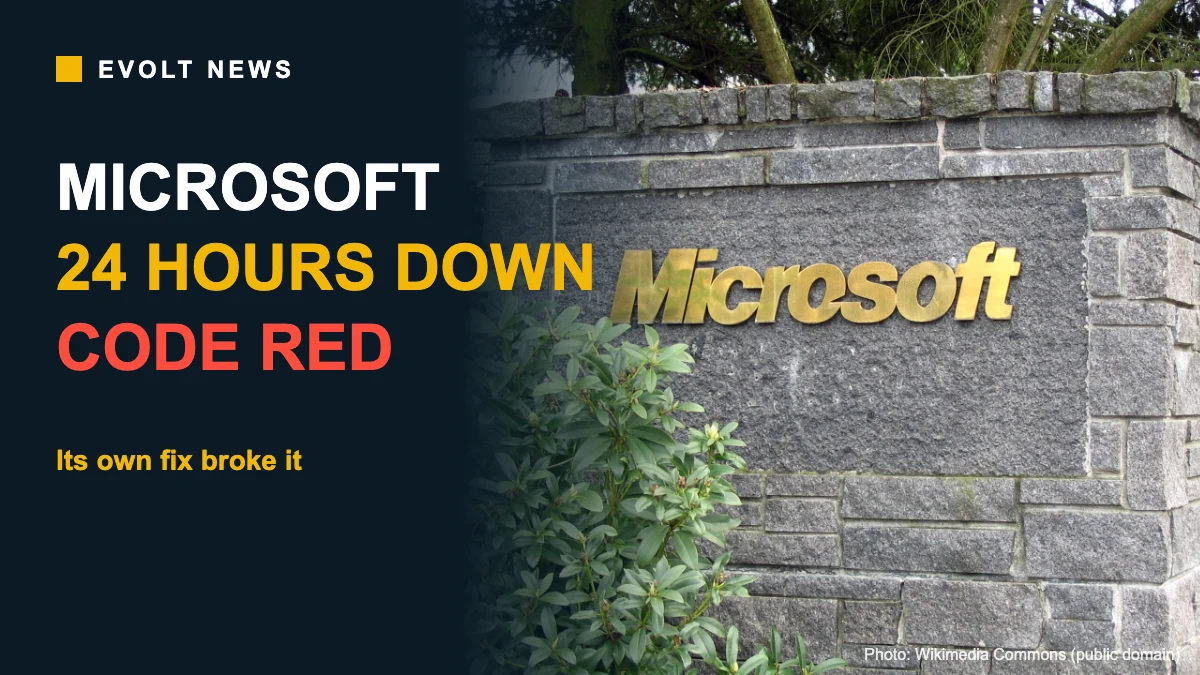
Featured image: Wikimedia Commons (public domain).
This article is opinion.
Microsoft 365 outage and Code Red: FAQ
When was the Microsoft 365 outage?
On November 12 and 13, 2026. It lasted nearly 24 hours and affected Exchange Online, Outlook, Teams and Copilot.
What caused the Microsoft outage?
A defect introduced in a July fix to Microsoft 365 networking gateway servers. Under certain load, lock contention inside an internal Windows process exhausted processor and memory resources. Microsoft says it was not a cyberattack and not caused by AI agents.
What is a Code Red at Microsoft?
It is Microsoft’s highest internal alert level. It makes the problem the top priority and pulls engineers off other work to fix it.
How bad was the outage?
At the worst point, more than 80% of the servers behind the service were unresponsive. Microsoft called it the most customer-impacting incident in the history of Exchange Online, and CEO Satya Nadella apologized.
What is Microsoft changing?
Microsoft set out five workstreams, including load shedding, geographic traffic partitioning and faster recovery, with the goal of resolving any future incident like this worldwide within one hour, helped by AI agents.
Sources: Reuters, SiliconANGLE, 9to5Mac, Microsoft.
Our Take
A July fix took down Microsoft 365 for nearly 24 hours, with more than 80% of the servers behind it unresponsive, and Microsoft answered with a Code Red.
To me, the real problem is a company too big to see its own systems, and the promised cure of more speed and more AI agents worries me more than it calms me.