Key takeaways
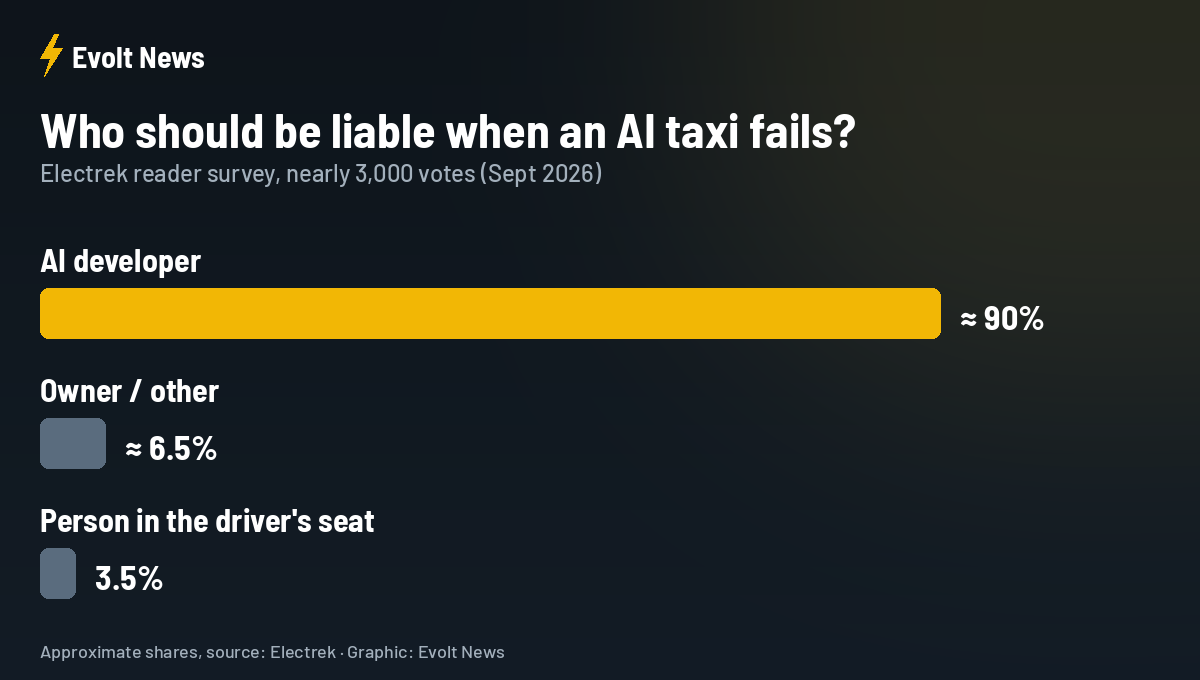
- In an Electrek reader survey with nearly 3,000 votes, about 90% said the AI developer should be blamed when a self-driving taxi fails. Only 3.5% blamed the person in the driver’s seat.
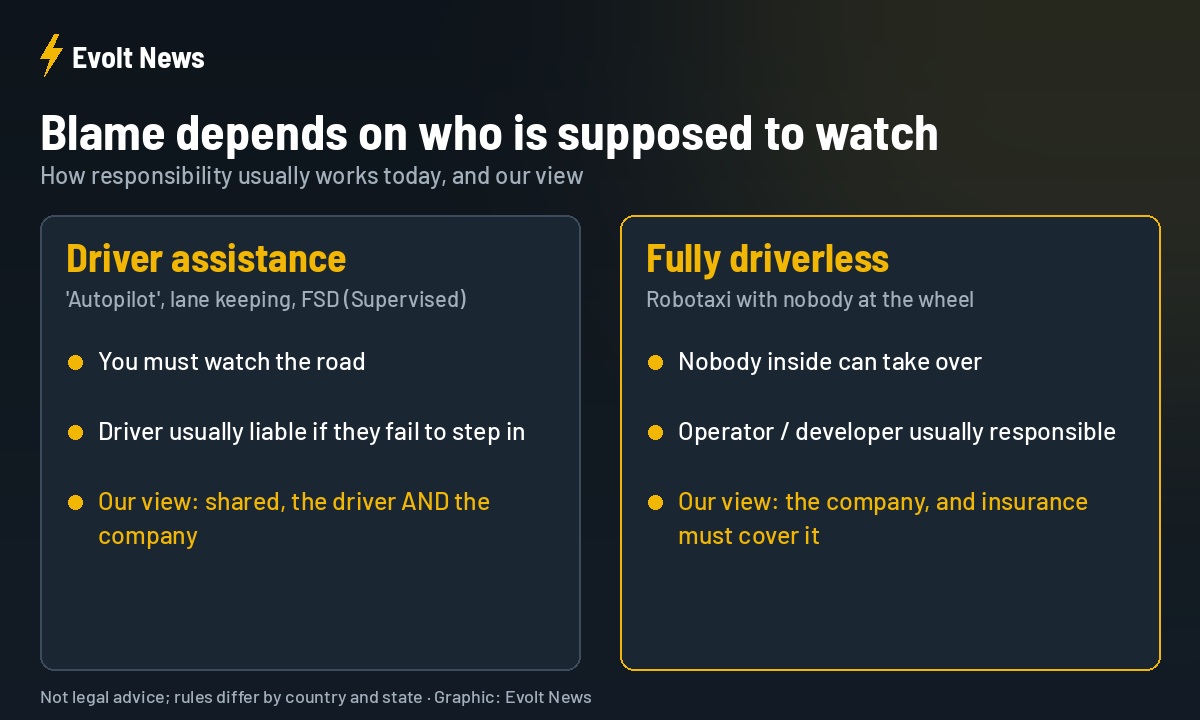
- Today, drivers using assistance systems like “autopilot” are usually still liable, while robotaxi operators generally carry responsibility when nobody is at the wheel.
- Our view: blaming the company alone is too simple when a human is supposed to be watching the road.
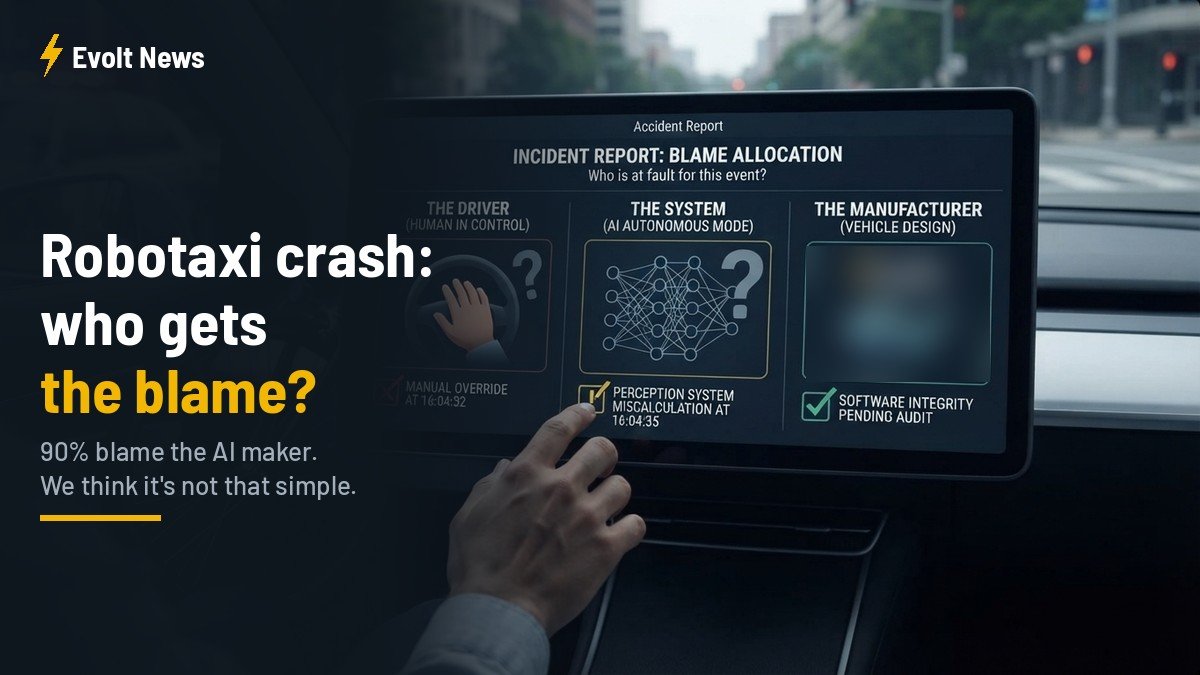
When a self-driving car crash happens, who is to blame? Electrek asked its readers exactly that, and nearly 3,000 people answered. The result was almost unanimous: about nine out of ten said the company that built the AI should be responsible. Only 3.5% put the blame on the person sitting behind the wheel.
We understand the instinct, but we do not fully agree. The honest answer depends on one simple question: was a human supposed to be watching the road, or not?
In this article: The survey · What it feels like · Why the driver still matters · When nobody is driving · Promises vs. reality · FAQ
What the survey found
The survey ran during a busy few weeks for autonomous driving. Several fatal crashes involving Tesla’s driver-assistance systems made headlines, Waymo’s robotaxis collected thousands of parking tickets in San Francisco, and Tesla showed its steering-wheel-free Cybercab again. Just days ago, a driverless Zoox robotaxi collided with a car on the Las Vegas Strip, sending the other driver to hospital. Fault has not yet been determined.
Readers split into three camps: the AI developer (the clear majority), the owner of the vehicle, and the human in the seat. One commenter suggested splitting the blame evenly between the car maker and the AI maker.
What it feels like to be driven by a machine
We have ridden in cars that drive themselves, and honestly, it felt like being in the future, or in a science-fiction film. What fascinated us most was not the technology itself, but the behaviour. The system follows the rules. It does not speed up just because the road looks empty.
That is the key difference from people. A human driver sees a chance to press the accelerator and takes it, without thinking about what could happen if they break the rules at that exact moment. A machine does not get impatient, tired or distracted by a phone. And we would take a robotaxi over a car driven by someone who has been drinking any day. Robotaxis are criticised a lot right now, and some of that criticism is fair, but a drunk human behind the wheel causes far more problems on the road.
Why the driver still matters
This is where we disagree with the 90%. When a car has an “autopilot” but a person sits behind the wheel, the situation is not black and white. Was the driver watching the road, or did they trust the system completely and stop paying attention?
Yes, the company that built the system carries a large part of the responsibility. But the same companies clearly tell drivers to keep watching and to step in when something goes wrong. If the driver could have intervened and did not, part of the blame is theirs. Putting everything on the company is simply not fair.
Courts seem to see it similarly. In a high-profile case in the United States, a jury found the Tesla driver 67% responsible for a fatal crash and Tesla 33% responsible, and added punitive damages against the company. That is shared blame in practice.
When nobody is driving
A true robotaxi is different. Nobody inside can take over, so the passenger cannot be blamed. In the US, operators of fully driverless services generally take responsibility while their system is driving, and some states are adding clear rules. California, for example, now allows police to cite the manufacturer directly when a driverless car breaks a traffic law, and Nevada requires robotaxi companies to carry at least $1.5 million of insurance per crash during rides.
We think this is exactly how it should work. Insurance companies know very well what can happen with a car that drives itself. It would be strange for a policy not to cover crashes caused by the system, when everyone knows the car is driving on its own.
Promises vs. reality
| Situation | Who usually carries responsibility today | Our view |
|---|---|---|
| Driver assistance, human must watch | Mostly the driver | Shared: driver and company |
| Fully driverless robotaxi | Operator or developer | The company, fully insured |
| Another human driver causes the crash | That driver | Agreed |
Part of the confusion comes from marketing. Tesla has sold its system for years as “Full Self-Driving”, while it still requires the driver to supervise it. In our view, Tesla promises more than it delivers. We are not fans of Elon Musk: he says a lot, and many of his statements and ideas are strange. Sometimes we feel it would be better if he said less in public. When a company’s boss keeps suggesting the car can drive itself, it is no surprise that some drivers stop watching the road.
Still, the direction is clear. Self-driving systems get smarter every year, and this is our future, whether we like it or not. We think many people over 45 will keep resisting the idea, while younger people will simply grow up with it, just as automatic gearboxes replaced manual ones.
Self-Driving Car Crash FAQ
Who is responsible if a Tesla on Autopilot or FSD crashes?
Usually the driver, because these are driver-assistance systems that require supervision. Courts can also assign part of the blame to the manufacturer.
Who pays if a robotaxi crashes?
When there is no human driver, the operating company and its insurer are generally responsible, unless another driver caused the crash.
Are self-driving cars safer than human drivers?
They follow traffic rules consistently and do not get tired or drunk, but they still make mistakes in unusual situations. The data is still being collected.
Can I be blamed as a passenger in a robotaxi?
Generally no. A passenger in a fully driverless taxi has no way to control the car.
Sources: Electrek, PIA Northeast, Nolo, Sam & Ash Law, Yahoo Finance. This article is not legal advice.