Key takeaways
- Apple warned two Thai opposition leaders, Abhisit Vejjajiva and Natthaphong Ruengpanyawut, that mercenary spyware had targeted their iPhones. Thai officials met Apple on November 11.
- The government denies any role, but its spokesman admitted state agencies had asked for money to buy Pegasus in the past. Officials now want the victims to hand over their alerts.
- My view: when a government that once wanted Pegasus asks the spied-on opposition for its evidence, I’m not sure who is investigating whom. And Apple, once again, says nothing.
Apple warned two Thai opposition leaders, former prime minister Abhisit Vejjajiva and People’s Party leader Natthaphong Ruengpanyawut, that mercenary spyware had targeted their iPhones, and Thai officials met Apple about it on November 11. The government denies any involvement, though its spokesman admitted that state agencies had previously requested money to buy Pegasus.
In this article: The fox wants to see the henhouse · “We asked for Pegasus, but nobody gave us the money” · 30 phones, and still no name · What can Apple say in that room? · My advice if you get the alert · FAQ
The fox wants to see the henhouse
Look at the order of things. The opposition gets a warning that someone is spying on its leaders. And the government, which says it has nothing to do with it, asks the victims to hand their alerts to state agencies, “to check if they are real.” So the people being watched should give their evidence to the side many of them suspect. To me, that is like asking the fox to check who broke into the henhouse. I’m not saying the Thai government did it. Nobody has proven who did. But if I were Abhisit, I wouldn’t hand anything to anyone except an independent lab.
“We asked for Pegasus, but nobody gave us the money”
The government spokesman said something I can’t get out of my head. Yes, state agencies did ask for a budget to buy Pegasus. But no money was given, not this year and not last year. So the wish was there. Only the money wasn’t, they say. And the defence ministry says its people don’t use spyware, but it can’t speak for the other agencies. When the answer is “not us, but we can’t speak for everyone,” that’s not an answer. That’s a door left open.
30 phones, and still no name
This isn’t the first time. In 2020 and 2021, during the pro-democracy protests, researchers found Pegasus on the phones of at least 30 Thai activists, academics and lawyers. Five years later, we still don’t officially know who put it there. And now the same story, only higher: the leaders of the opposition. I already wrote that Apple warned 99 countries and still won’t say who is behind it. Thailand shows why that silence matters. When nobody is ever named, nobody is ever afraid.
What can Apple say in that room?
Apple met the Thai ministry. Nothing from the meeting will be published. So I’m asking: what can Apple even say there? If it shares how it detects these attacks, the attackers learn how to hide. If it says nothing, the government leaves with empty hands and its own story. And the opposition leaders, the real victims, weren’t even in the room. Apple likes to say privacy is a human right. Here, I’d like to see whose human rights it protects first.
My advice if you get the alert
If Apple ever shows you this warning, don’t send it to your government, and don’t panic. Turn on Lockdown Mode (Settings → Privacy & Security → Lockdown Mode), update to the latest iOS, and contact an independent group like Amnesty’s Security Lab or Access Now’s helpline. They check phones for free, and they don’t work for any government.
Also on Evolt News: iOS Sandbox Escape Is Public. A Crypto Exchange Warned iPhone Users Before Apple Did · Apple Warned 99 Countries About Spyware. It Still Won’t Say Who’s Behind It · Apple Locks AI Agents Out of Your Mac. And Who Will Lock Out Siri? · Apple Stores Signed People Up for Subscriptions Without Asking. And Apple Still Says Nothing
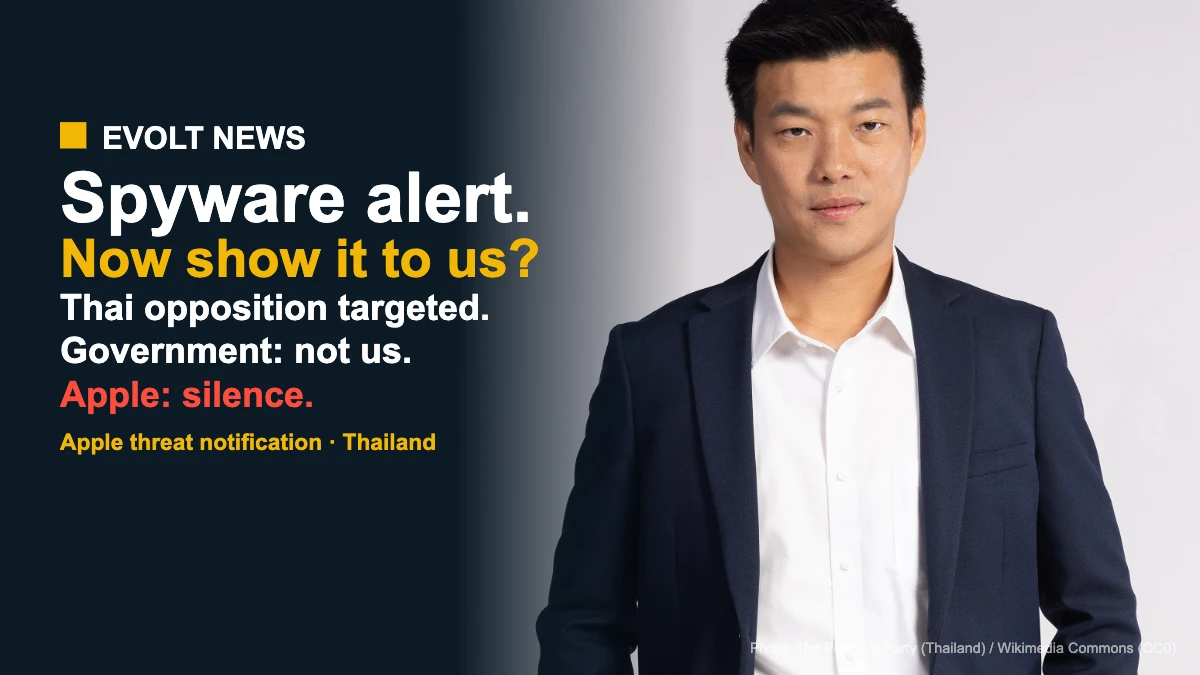
Featured image: Natthaphong Ruengpanyawut, The People’s Party (Thailand) / Wikimedia Commons (CC0).
This article is opinion.
Apple spyware alerts in Thailand: FAQ
Who received Apple’s spyware warnings in Thailand?
Former prime minister Abhisit Vejjajiva and People’s Party leader Natthaphong Ruengpanyawut, in early November 2026.
Did Thai officials meet Apple?
Yes. The Ministry of Digital Economy and Society met Apple on November 11, according to Bloomberg. No details from the meeting will be released.
Does the Thai government deny involvement?
Yes. Its spokesman also said state agencies had previously requested budget for Pegasus, but no money was allocated in this or the previous fiscal year.
Were the phones actually hacked?
That isn’t confirmed. Apple’s alerts mean a phone was targeted, not that an infection was proven. Abhisit’s party says his phone was not compromised.
Has Pegasus been used in Thailand before?
Yes. Researchers found Pegasus on the phones of at least 30 Thai activists, academics and lawyers in 2020 and 2021. The operator was never officially identified.
What should you do if you get Apple’s threat notification?
Turn on Lockdown Mode, update iOS and contact an independent lab such as Amnesty’s Security Lab or Access Now’s Digital Security Helpline.
Sources: Bloomberg, AppleInsider, AFP, Thai Examiner, Citizen Lab, Amnesty International.
Our Take
Apple’s warnings show that someone targeted Thailand’s opposition leaders, but not who. The government denies it while admitting agencies once sought Pegasus.
Victims of state-level spyware should take their phones to independent labs, not to any government. And Apple’s silence protects attackers as much as targets.