Key takeaways
- Apple memory supplier SK Hynix said on October 28 that demand will exceed supply until at least 2030. Apple is one of 14 priority customers, but its contracts follow market prices, and circuit boards may be the next shortage.
- Apple raised prices on 14 products in June and said it did so “reluctantly”. The flash for a 256GB-to-512GB iPhone upgrade now costs Apple about $66, up from $15. Apple still charges $200, and the Wall Street Journal estimates its storage upgrades bring over $10 billion in gross profit at about 85% margins.
- My view: “reluctantly” is hypocrisy. The memory crisis is real, but Apple used it to raise the price of almost everything, even devices where memory hardly matters.
On October 28, SK Hynix, one of Apple’s main memory suppliers, said that “supply is not keeping pace with the growth of the market” and that it expects demand to exceed supply “through 2030”. AI data centers are buying most of the new memory. Apple is reportedly one of 14 customers with long-term priority contracts, but those contracts include a mechanism that follows market prices, and Nikkei reports that printed circuit boards may be the next component in short supply.
In June, Apple raised prices on 14 products, from the Mac and iPad to Apple TV and HomePod, saying it had “never seen a component price increase this much, this quickly”. Tim Cook called it a “hundred-year flood” and said Apple raised prices “reluctantly”. According to the Wall Street Journal, the flash memory behind a 256GB-to-512GB iPhone upgrade now costs Apple about $66, up from $15, while Apple still charges $200. Apple reports its next results on November 2, the first with John Ternus as CEO.
| Product | Before June 2026 | After | Increase |
|---|---|---|---|
| MacBook Neo | $599 | $699 | +$100 |
| MacBook Air 13-inch | $1,099 | $1,299 | +$200 |
| MacBook Pro M5 | $1,699 | $1,999 | +$300 |
| Mac Studio M3 Ultra | $3,999 | $5,299 | +$1,300 |
| iPad (A16) | $349 | $449 | +$100 |
| iPad Air 11-inch | $599 | $749 | +$150 |
| Apple TV 4K | $129 | $199 | +$70 |
| HomePod mini | $99 | $129 | +$30 |
| Vision Pro | $3,499 | $3,699 | +$200 |
In this article: “Reluctantly”? For $134 on every upgrade · They found an excuse for everything · “We’ll soften the increases.” We can see that · Apple lost its whip, and I’m a little happy · Where were the calls for the government? · An excuse until 2030 · November 2: let’s see the margin · FAQ
“Reluctantly”? For $134 on every upgrade
You know what? When Apple says it raised prices “reluctantly”, what the hell is that? The memory went up to $66, and Apple still charges $200 for that upgrade. So it takes $134 on top. For what? Only the memory got more expensive, nothing else. The other parts are old, and I assume they cost about the same as before.
So it is not only that this came out. It is that they are hypocrites when they talk like they did not want to raise prices. And in the end they raised even the MacBook Neo for students, by $150 in one year.
Do you understand what this means? Storage upgrades alone bring Apple more than $10 billion in gross profit, at a margin of about 85%. Only from storage. Eighty-five percent.
They found an excuse for everything
Don’t forget that Apple makes money on everything: AppleCare, subscriptions, the App Store. In the end we even buy adapters for the wall socket from them. Everything is so overpriced. In my opinion, they just found something to blame it all on, and that is memory. Good Lord, will anyone notice? Or are people really able to pay even for air from Cupertino?
Why did they raise the price of things like Apple TV and HomePod, where memory hardly plays a role? Apple TV went up by $70, HomePod mini by $30. And I am sure the older devices, with memory Apple probably bought cheaply long ago, suddenly cost $100 or $150 more too. I think that is just pulling money out of us.
“We’ll soften the increases.” We can see that
In June, Apple said it wanted to soften the price increases. Aha. We can see how you do it: you raised the price of almost everything you have, including the older devices. The increases went from $30 for a HomePod mini to $1,300 for a Mac Studio, most of them $100 to $300.
Analysts now expect computer sales to fall by about 10% this year. I believe it. And phones? They say about 8%. I expect more.
Apple lost its whip, and I’m a little happy
And this is what I like. Until now, Apple decided, you could say, how it would buy storage from suppliers. The Wall Street Journal wrote that for years Apple bullied flash makers into steep discounts.
But now, suddenly, Apple is not the priority for the storage market. There are bigger players now, the AI companies, who buy more than Apple. The biggest cloud buyers now buy more than twice as much flash as Apple. So suppliers don’t have to jump in front of Apple and give it discounts anymore.
I know that in the end, we are the ones who suffer from all this. But maybe it shows that Apple is not number one in everything anymore, that the world moves on, and Apple can’t just say what it wants. That makes me a little happy.
Where were the calls for the government?
Now people are calling for the government to help with memory prices. Funny. When Apple was playing with its suppliers, nobody cared, nobody called for the state to help the suppliers. Apple were the heroes.
But nobody calls for help when Apple raises the price of every gadget, even the one with old memory, and suddenly we find out it costs $150 more. That is “normal”, AI is developing, or the Apple fans say you are not supposed to criticize it. Why does nobody accuse Apple of just wanting to pull money out of us? Why does everyone stay silent at this time, and nobody gives a damn?
And why is everyone talking about how consumers pay for data centers and AI they don’t even use? Memory goes where it is needed, that is normal. Everything goes in a completely different direction when people talk about Cupertino. The biggest problem is that Apple raised prices by up to hundreds of dollars on almost everything, while the memory in a $200 upgrade costs it $66.
An excuse until 2030
And now the most important part. Apple has a lever on prices, with the excuse of memory and, soon, circuit boards. Until 2030, if nothing changes, and maybe even longer. Yes, that long.
In June it was the Macs and iPads. Now it is the iPad mini for $699, the touchscreen MacBook Pro for $400 more and the Apple TV. Every year there will be something to blame.
November 2: let’s see the margin
I am curious what margin Apple will show on November 2, at Ternus’s first results as CEO. There we will learn more about this overpricing, and how they “softened” everything.
The way I see it, we will see big numbers. From a corporation that lately goes only after money, not after innovation. And we are supposed to stay quiet, while Apple stands still and shows us nothing new as innovation.
Also on Evolt News: iPhone record market share and the memory crisis · MacBook Pro M6 for $1,999
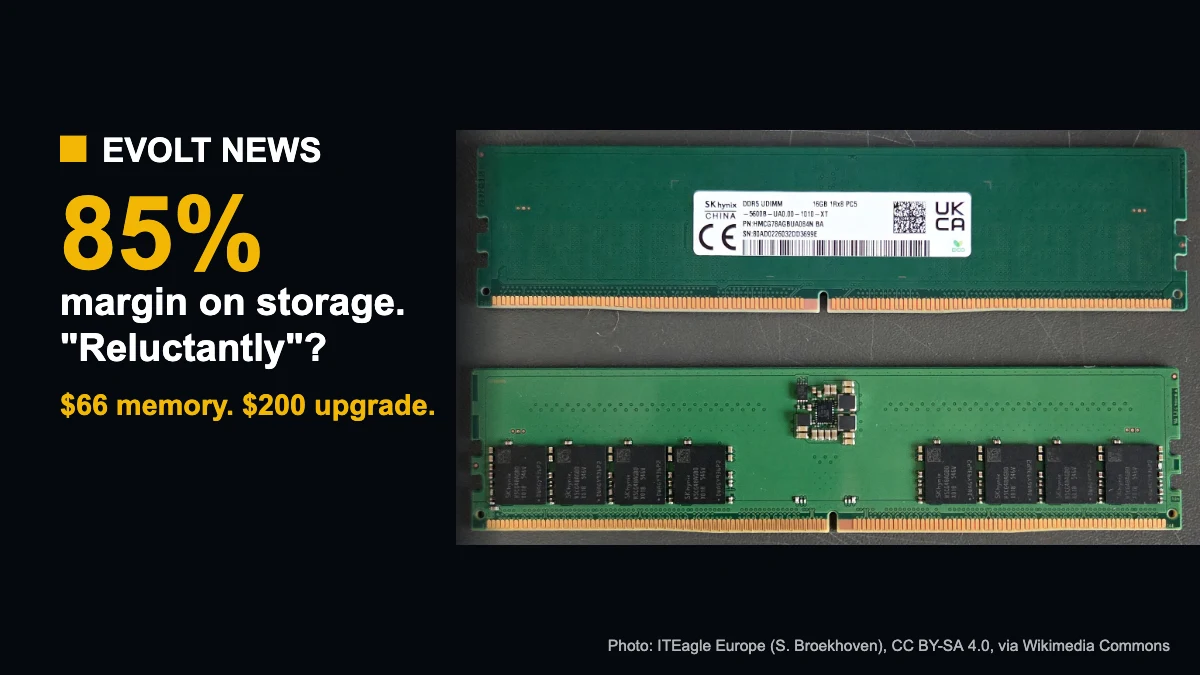
Photo: SK hynix DDR5 memory module. ITEagle Europe, Sebastiaan Broekhoven, CC BY-SA 4.0, via Wikimedia Commons.
This article is opinion.
Apple prices and the memory crisis: FAQ
Why is Apple raising prices in 2026?
Apple says memory and storage prices rose sharply because AI data centers are buying most of the supply. In June 2026, it raised prices on 14 products, including Macs, iPads, Apple TV, HomePod and Vision Pro.
How long will the memory shortage last?
SK Hynix said on October 28, 2026, that it expects demand to exceed supply through 2030. Other forecasts expect some easing for flash memory in 2027.
How much does memory cost Apple for an iPhone storage upgrade?
According to the Wall Street Journal, the flash for a 256GB-to-512GB iPhone 17 Pro upgrade costs Apple about $66, up from $15. Apple charges $200 for that upgrade.
How much does Apple earn on storage upgrades?
The Wall Street Journal estimates Apple makes more than $10 billion in gross profit from storage upgrades, at margins of about 85%.
Should I buy an Apple device now or wait?
Most forecasts expect prices to stay high or rise further into 2027 and beyond. Options include buying the base storage and using iCloud or an external SSD, buying refurbished or the previous model, or keeping your current device longer.
Sources: SK Hynix, Wall Street Journal, 9to5Mac, AppleInsider, MacRumors, Nikkei Asia, TechInsights, Gartner, 24/7 Wall St.
Our Take
The memory shortage is real, and SK Hynix expects it to last until 2030. But Apple still charges $200 for a storage upgrade that costs it about $66, and it raised prices even on products where memory hardly matters.
The way I see it, “reluctantly” is not the right word. Apple found a story it can repeat for years.