Key takeaways
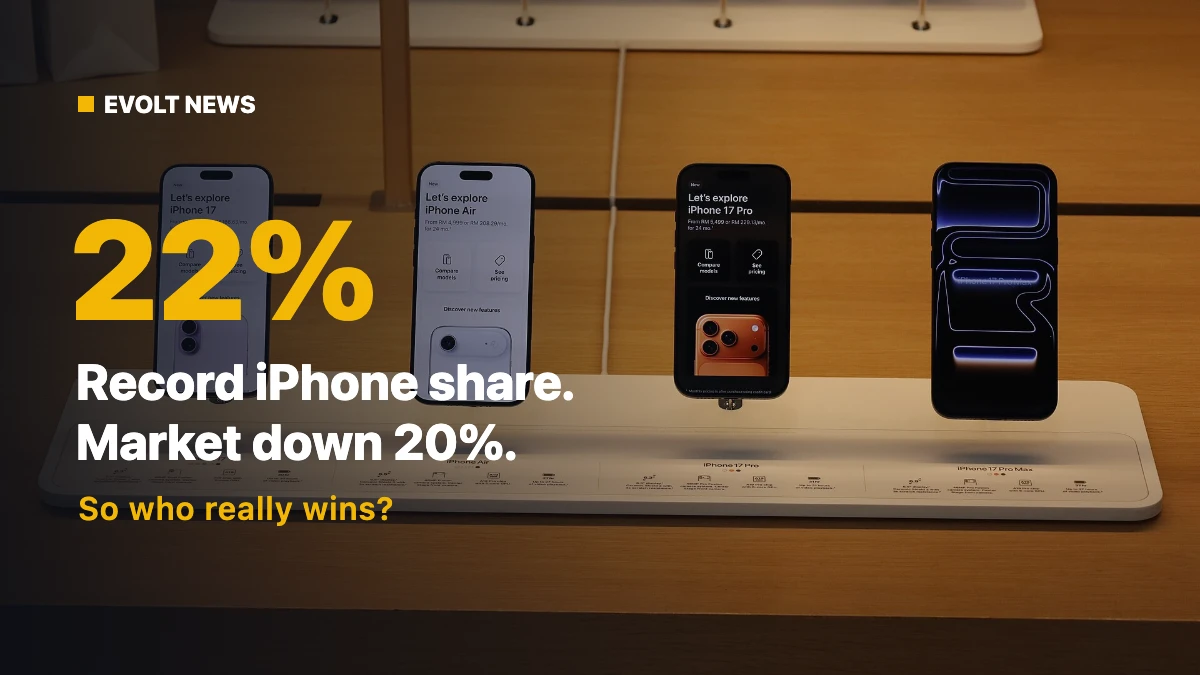
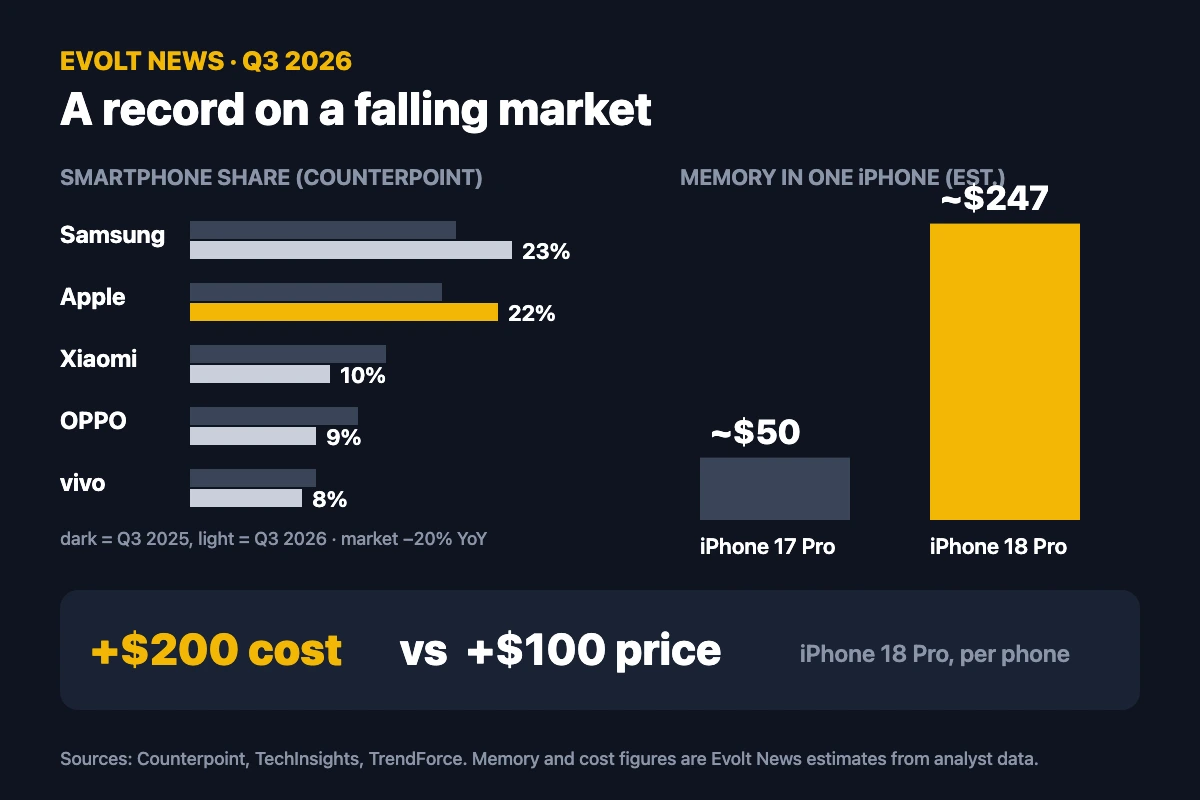
- According to Counterpoint Research, global smartphone shipments fell 20% in Q3 2026, the lowest third quarter in 14 years. Apple reached a record 22% share, but shipped fewer iPhones than a year ago.
- The reason is the memory crisis: phone prices are up about 20% this year. By my rough math from TechInsights and TrendForce data, memory in an iPhone 18 Pro costs about $247, up from about $50 a year ago, while the price went up $100.
- My view: Apple is not winning because people buy more iPhones. People keep phones longer and buy refurbished. And the real winners of this crisis, in my opinion, are the memory makers and AI.
Apple has a record. According to Counterpoint Research, as reported by 9to5Mac, Apple shipped 22% of all smartphones in the third quarter of 2026, up from 18% a year ago. That is the first time Apple crossed 20% in any third quarter. Samsung is still first with 23%.
But here is the part nobody puts in the headline. The whole smartphone market fell 20% year over year, to its lowest third quarter in 14 years. And Apple itself shipped fewer phones than last year. Xiaomi fell more than 30%. OPPO and vivo fell more than 20%. Apple did not win by selling more. It won because the others fell harder.
In this article: A record on a falling chart · Fewer iPhones, more money · The memory crisis: I did the math · So who is really making money on it? · People keep phones longer. Finally · Is this the end of cheap phones? Not so fast · Nikkei, “soft demand” and the stock game · Will Apple pass Samsung? · Profit over sales: good for them, bad for us · Would I buy a refurbished iPhone? Yes · FAQ
A record on a falling chart
When I hear this debate, it is a bit strange to me. When we look at the charts, you can see they won only because they were smart and raised prices. Not because they won by the number of phones sold.
And there is one catch nobody sees. The trend is going down, even if Apple is announcing records right now. That does not mean the same principle will keep working. The trend shows people now buy a phone not for one year, but for three years or more. And nobody talks about a trend that is growing a lot all over the world: people are looking for refurbished or second-hand phones.
Fewer iPhones, more money
Counterpoint says Apple’s volume fell mostly because there was no base iPhone 18 this year, and Apple also raised prices at the end of the quarter. At the same time, the iPhone 18 Pro had a stronger launch than its predecessor, especially in China and India.
Yes, it is fall now, when everything sells more before Christmas. Maybe they won. But I am not sure the trend of raising prices will keep helping them: selling fewer phones, but with a bigger margin.
And about China and India: when you count how mega huge those markets are, we do not even have to go further. That alone explains a stronger start.
The memory crisis: I did the math
Phone prices are up about 20% since the start of 2026, because memory got more expensive. My first reaction was: this is a fairy tale, so they can make a huge margin. So I wanted the numbers.
According to TechInsights, a 12GB memory chip, the amount in the iPhone 18 Pro, cost about $165 at launch, and 256GB of storage about $82. That is about $247 of memory in one phone. TrendForce says memory was about 10% of the iPhone 17 Pro’s component cost a year ago, and is about 34% now, with total component cost up about 38%.
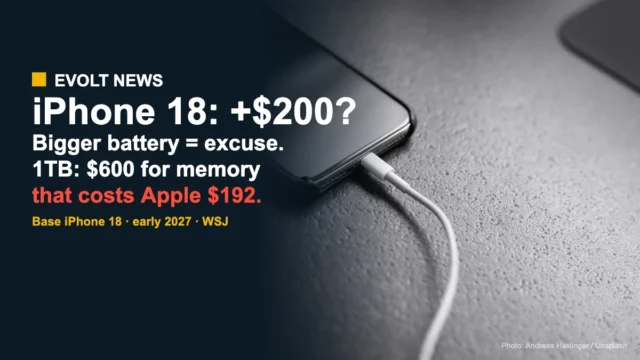
If I put that together, my rough estimate is: memory in an iPhone went from about $50 to about $247, and the components cost about $200 more per phone. And the price for us? The iPhone 18 Pro costs $1,199, $100 more than the iPhone 17 Pro.
I will be honest: by these numbers, Apple did not invent the memory crisis. On the iPhone 18 Pro, it seems Apple paid part of it itself. These are analyst estimates, without development or marketing costs. But they are the best numbers we have.
So who is really making money on it?
And here is the question that matters. If memory is five to seven times more expensive than in early 2025, where does that money go? To the memory makers. Micron posted record earnings, and Samsung and SK Hynix are expected to make record profits this year, driven by AI.
Because the memory is going to AI. The giant AI models and data centers buy up memory at any price. And we, normal people, pay more for our phones so AI companies can have their chips. That is the real story behind the 20%.
And Apple? It sells fewer phones, more expensive, and reports records to investors. In my opinion, that is the game: we read “memory got more expensive” and we do not ask the most important question, who earns more because of it.
People keep phones longer. Finally
It is already slowly here. When we read comments from normal people, not Apple fans who would do anything to get a new iPhone, we see the trend of keeping a phone three or four years is closer. The numbers show it too: even if the companies are up financially, the number of phones sold dropped a lot.
And I am glad that at least this way, people are forced to think. Buying a new phone every year is madness. A phone that is almost the same as a year ago, even if they tell us it is 50% better. Nobody feels it. It is still a phone for communication. It is not a remote control for some universe.
Is this the end of cheap phones? Not so fast
Xiaomi, OPPO and vivo fell 20 to 30%. But I would not hurry. If memory prices keep rising because of the mega fast AI models, the cards can still turn. Apple can keep raising iPhone prices, even every year. And then there will be a ceiling, when people say: fine, it is Apple, but this is too much. I will pay less, and I can still chat and call. I will take something cheaper. So I would wait with that.
Nikkei, “soft demand” and the stock game
Last week, Nikkei Asia wrote about iPhone 18 Pro cuts because of “soft demand”, and I wrote about the iPhone 18 Pro production cut too. Apple’s stock fell about 2.5%. Now Counterpoint says the 18 Pro had a stronger launch. And JP Morgan raised its Apple price target from $340 to $360, saying the cuts look like Apple’s usual production pattern.
That pulls me to the side that it was more speculation on the market. Somebody always makes money on news like that. When the price drops, the big players buy more. And we, people who love everything about Apple, saw the news, jumped on it, blew it up even more and helped the speculators. That is my theory, I have no proof. But it is worth thinking about. I also believe the 18 Pro had a better start.
I already wrote about this in the iPhone Duo orders article: be careful what you read.
Will Apple pass Samsung?
It can easily happen. They have been fighting for years. Samsung has more phone lines on the market, so it is hard. But Apple can jump now with the iPhone Duo and pass Samsung, even if Samsung has a bigger selection.
Profit over sales: good for them, bad for us
Counterpoint says phone makers now prioritize profit over volume. That makes me angry at the manufacturers. It is openly said that they prioritize profit right now. We only read that memory got more expensive and accept it, and we do not want to know the most important thing: even when memory got more expensive, someone in this chain earns more.
Would I buy a refurbished iPhone? Yes
Why not? Manufacturers now give a warranty even on refurbished phones. I do not see anything bad in it. Rather the opposite: it protects my wallet, and I will have a good phone. That is not bad at all.
Featured photo: Ahmad Ali Karim, CC0, via Wikimedia Commons
iPhone market share: FAQ
Did Apple reach a record smartphone market share?
According to Counterpoint Research, Apple shipped 22% of all smartphones in Q3 2026, up from 18%, the first time it crossed 20% in any third quarter. Samsung remained first with 23%.
Why did the smartphone market fall 20%?
Counterpoint blames the memory crisis: rising DRAM and NAND prices and shortages. Retail phone prices are up about 20% since the start of 2026.
How much does memory cost in an iPhone 18 Pro?
Based on TechInsights component prices, about $165 for 12GB of DRAM and about $82 for 256GB of storage at launch, roughly $247. TrendForce says memory is about 34% of the iPhone 18 Pro’s component cost, up from about 10% a year earlier.
How much does the iPhone 18 Pro cost?
The iPhone 18 Pro starts at $1,199 and the iPhone 18 Pro Max at $1,299, $100 more than the iPhone 17 Pro models.
Who profits from the memory crisis?
Memory makers. Micron reported record earnings, and Samsung and SK Hynix are expected to post record profits in 2026, driven by AI demand.
Sources: Counterpoint Research, 9to5Mac, TechInsights, TrendForce, MacRumors, AppleInsider.
Our Take
Apple’s record is real, but it is a record on a falling chart. Fewer iPhones, higher prices, and people keeping phones longer.
I did the math: the memory crisis is real, and on the iPhone 18 Pro Apple seems to have paid part of it. In my opinion, the real winners are the memory makers and AI. We pay so AI companies can have their chips.
Keep your phone longer. Consider refurbished. A phone is for communication, not a remote control for the universe.