Key takeaways
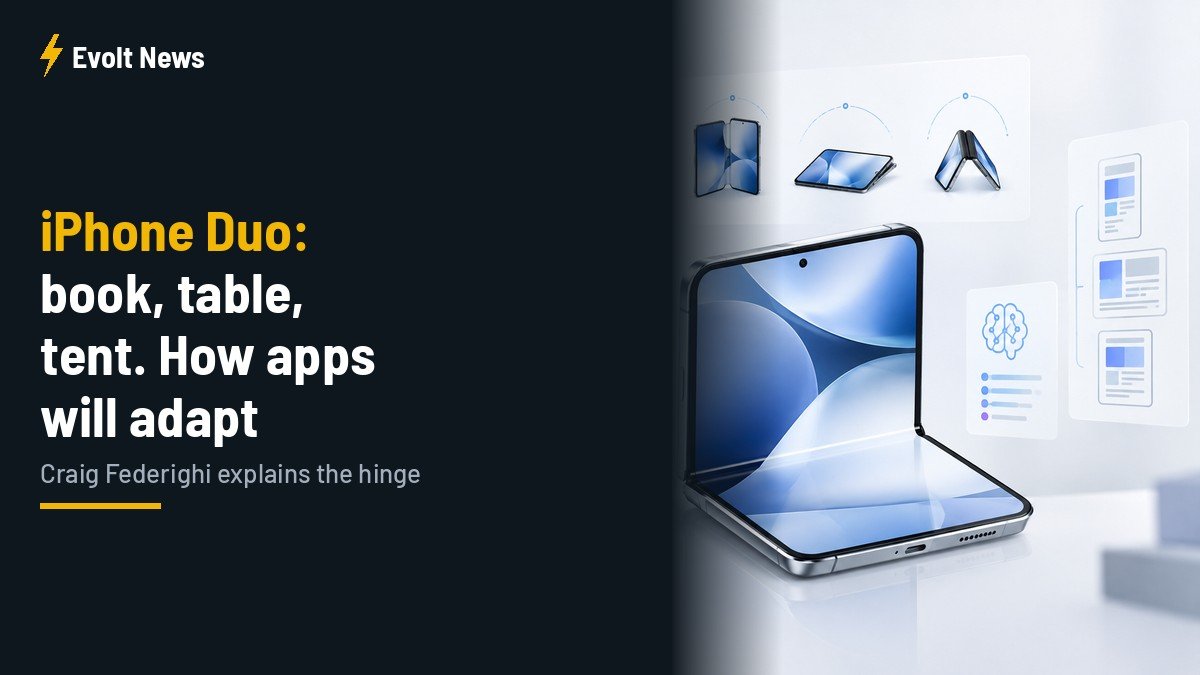
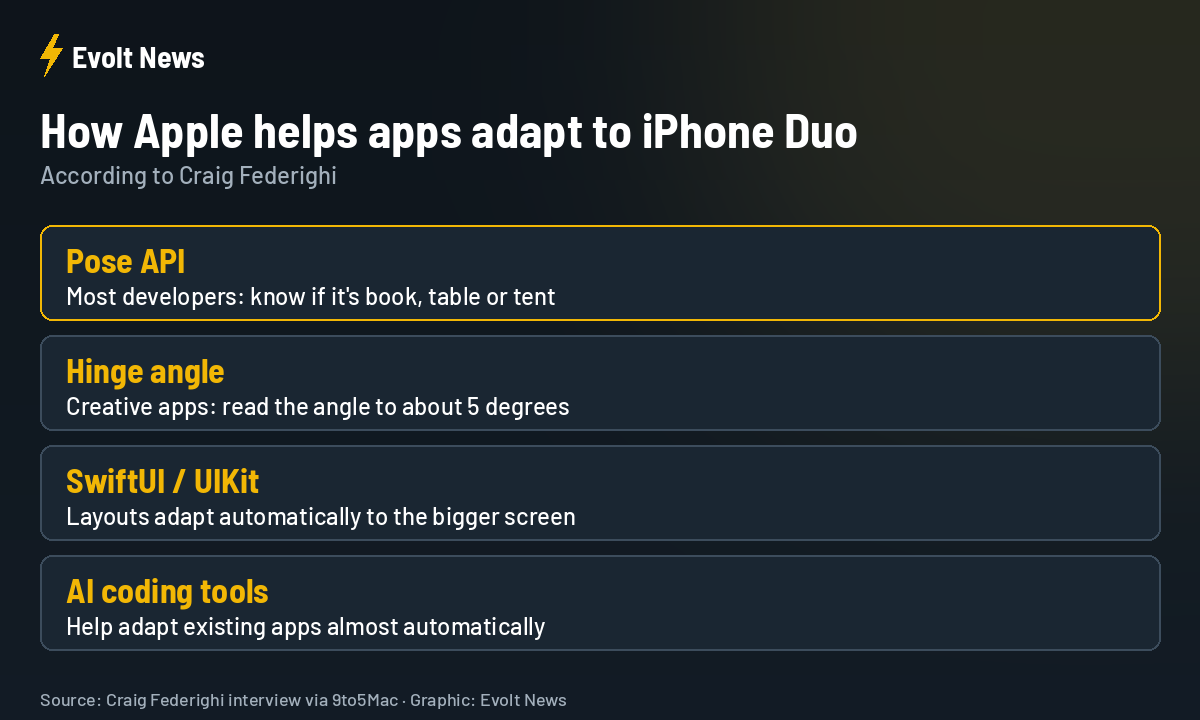
- Apple software chief Craig Federighi says iPhone Duo apps can read the hinge angle to about five degrees, but most developers will simply use “poses”: book, table or tent.
- Apple’s frameworks and AI coding tools are meant to make many apps adapt to the foldable almost automatically.
- Our view: the see-through opening effect is a nice detail, but the poses are what will really change how people use a phone.
iPhone Duo apps are the big unknown before Apple’s first foldable launches on October 23. A phone is only as good as the apps that run on it, and a folding screen changes everything about layout. In a new interview with YouTuber Donald Decodes, Apple software chief Craig Federighi explained how Apple is helping developers get ready.
We watched the interview closely. Some of it confirms what we expected from Apple. One part, the poses, is what we are genuinely most excited about.
In this article: The hinge as a sensor · Book, table, tent · The see-through screen · Will apps be ready? · FAQ
The hinge becomes a sensor
According to Federighi, developers can read how far the iPhone Duo is opened with an accuracy of around five degrees. But Apple does not expect most apps to work with raw angles. Instead, the system tells apps which pose the phone is in, and the frameworks react automatically, so the experience stays consistent across apps.
Federighi compares it to the gyroscope and accelerometer. When Apple opened those sensors to developers years ago, people built things nobody had predicted. He expects the same creativity with the hinge.
Is this completely new? Not really. Android foldables have offered developers similar posture information for some time. But we trust Apple’s approach here, and not just because Federighi says so. When the head of Apple’s software explains it himself, he knows exactly what he is talking about. Letting developers focus on the pose, not on degrees, is a smart and practical choice.
Book, table, tent: the part we are most excited about
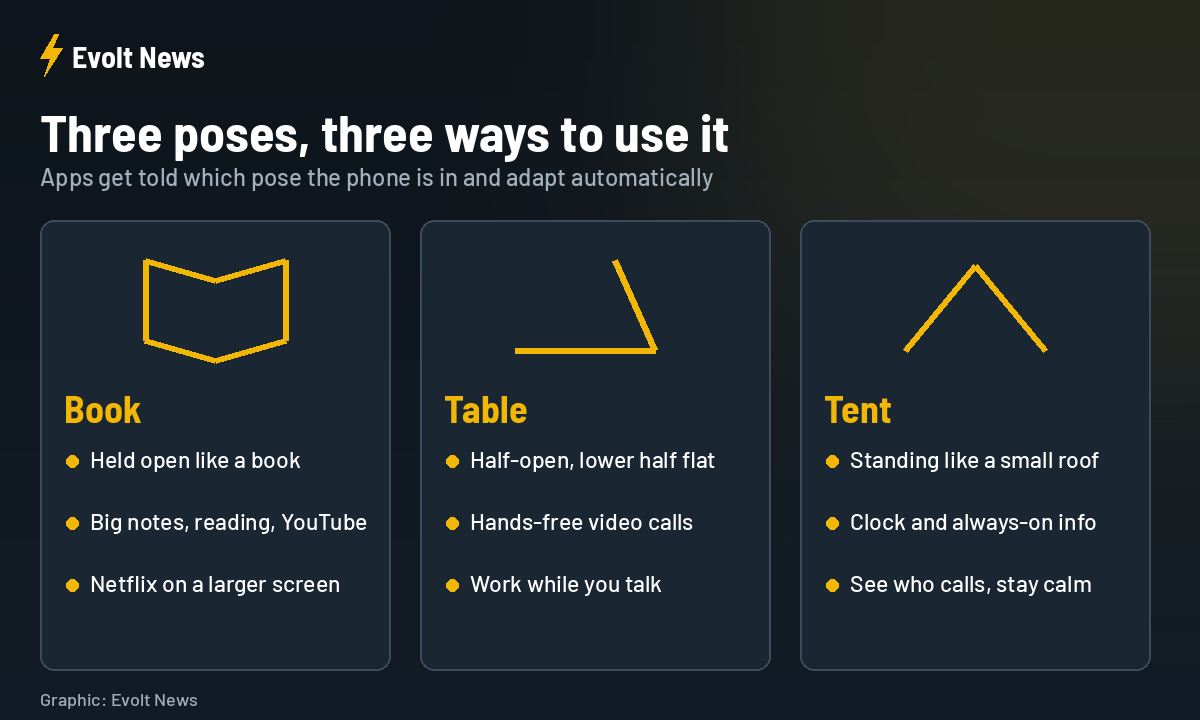
For us, this is by far the most interesting part of iPhone Duo. You can hold it open like a book, fold it half-open on a table like a tiny laptop, or stand it up like a tent. Each pose changes what the phone is good at.
Tent pose. Picture sitting in the office, or at home in the evening. You stand the Duo up and it becomes a clock with an always-on display, showing your notes, who is calling and who is writing. You get some peace from your phone, while still seeing everything important at a glance. This is the feature we are looking forward to most.
Table pose. Apple’s own ad shows video calls with the phone set up like a small laptop. You can work and talk at the same time, without holding the phone in your hand. We are sure users will really value this.
Book pose. This is where larger notes, YouTube and Netflix will shine. We are especially curious how an app like Instagram will look on a screen that size.
Foldable phones have been on the market for years. But this is what Apple does: it waits longer, then brings something new to an existing technology and takes it to a higher level. That is why the wait usually feels worth it.
The see-through screen: “subtle but magical”?
Apple also uses the hinge angle for its own software. The most talked-about example: as you open the Duo, the outer screen blurs and becomes translucent, like a window showing what is waiting on the inner display. Federighi called it “subtle but magical”, and says it quickly became a favourite.
We are more sceptical. Honestly, the whole internet is excited about it, but for us it is just a nice detail, nothing more. After a while, nobody notices it. You pay attention to your phone when you are watching content or chatting with friends, not to how the screen fades while it opens.
Will apps be ready on day one?
Federighi says Apple built its platform on frameworks like UIKit and SwiftUI that handle many difficult layout problems, so a lot of apps get new behaviour automatically. Apple also supports AI coding tools that can help developers adapt existing apps almost automatically.
Our realistic expectation: in the first months, some apps may look a little strange on the big screen. That can happen with any new form factor. But we are confident Apple will fix these issues quickly, and the most popular apps will adapt fast.
| Feature | What it means for you |
|---|---|
| Pose detection | Apps rearrange themselves for book, table or tent |
| Hinge angle (about 5°) | Creative apps and games can react to how far it is open |
| Automatic layouts | Many apps work on the big screen without an update |
| AI coding tools | Developers can adapt older apps faster |
iPhone Duo Apps FAQ
When is iPhone Duo released?
On October 23, 2026, starting at $1,999.
What are iPhone Duo poses?
Book, table and tent. The system tells apps which pose the phone is in so they can adapt their layout.
Will my apps work on iPhone Duo?
Many will adapt automatically thanks to Apple’s frameworks, but some may look unusual on the large screen at first.
What is the see-through effect?
When you open the Duo, the outer screen blurs and turns translucent, showing a preview of the inner screen.
Sources: Craig Federighi interview with Donald Decodes, 9to5Mac.