Key takeaways
- Tesla’s Cybercab has 8 crashes on file with NHTSA after about two months of public rides: four driverless, all at 5 mph or less, and four with a test driver and FSD engaged, one at 53 mph on a Philadelphia highway.
- Tesla’s own safety report claims zero injuries over 3.1 million driverless miles. It leaves out the Cybercab test fleet, where two crashes had injuries.
- My view: Tesla’s robotaxi looks safe because it barely moves. And on the same day, Tesla announced a factory for a million of them a year. That’s not a plan, it’s a show.
Tesla’s Cybercab has 8 crashes on file with NHTSA after about two months of public rides in Austin: four driverless ones, all at 5 mph or less, and four with a test driver and FSD engaged, including one at 53 mph on a Philadelphia highway. On the same day, Tesla announced a €3 billion Cybercab factory at Giga Berlin for up to 1 million cars a year, starting in 2029.
In this article: How we got here · By the numbers · Zero injuries, if you don’t count · Safe because it barely moves · 53 mph and a black box again · Testing where it has no permit · A million Cybercabs for a continent that allows 1,500 · My prediction · Verdict · FAQ
How we got here

| When | What happened |
|---|---|
| February 2026 | The first Cybercab leaves Giga Texas. |
| September 2026 | Cybercab public rides in Austin. Four test-fleet crashes with FSD engaged, one at 53 mph on a Philadelphia highway. |
| October 2026 | A Cybercab loses a door panel in a crash on Broad Street, Philadelphia. |
| October 21 | Tesla’s Robotaxi Safety Report: zero injuries over 3.1 million driverless miles. |
| November 6 | Tesla keeps its Cybercab safety answers to NHTSA secret. |
| November 16 | NHTSA data shows 8 Cybercab crashes. Tesla announces a €3 billion Cybercab factory in Berlin. |
By the numbers
| Number | |
|---|---|
| Cybercab crashes on file with NHTSA | 8 |
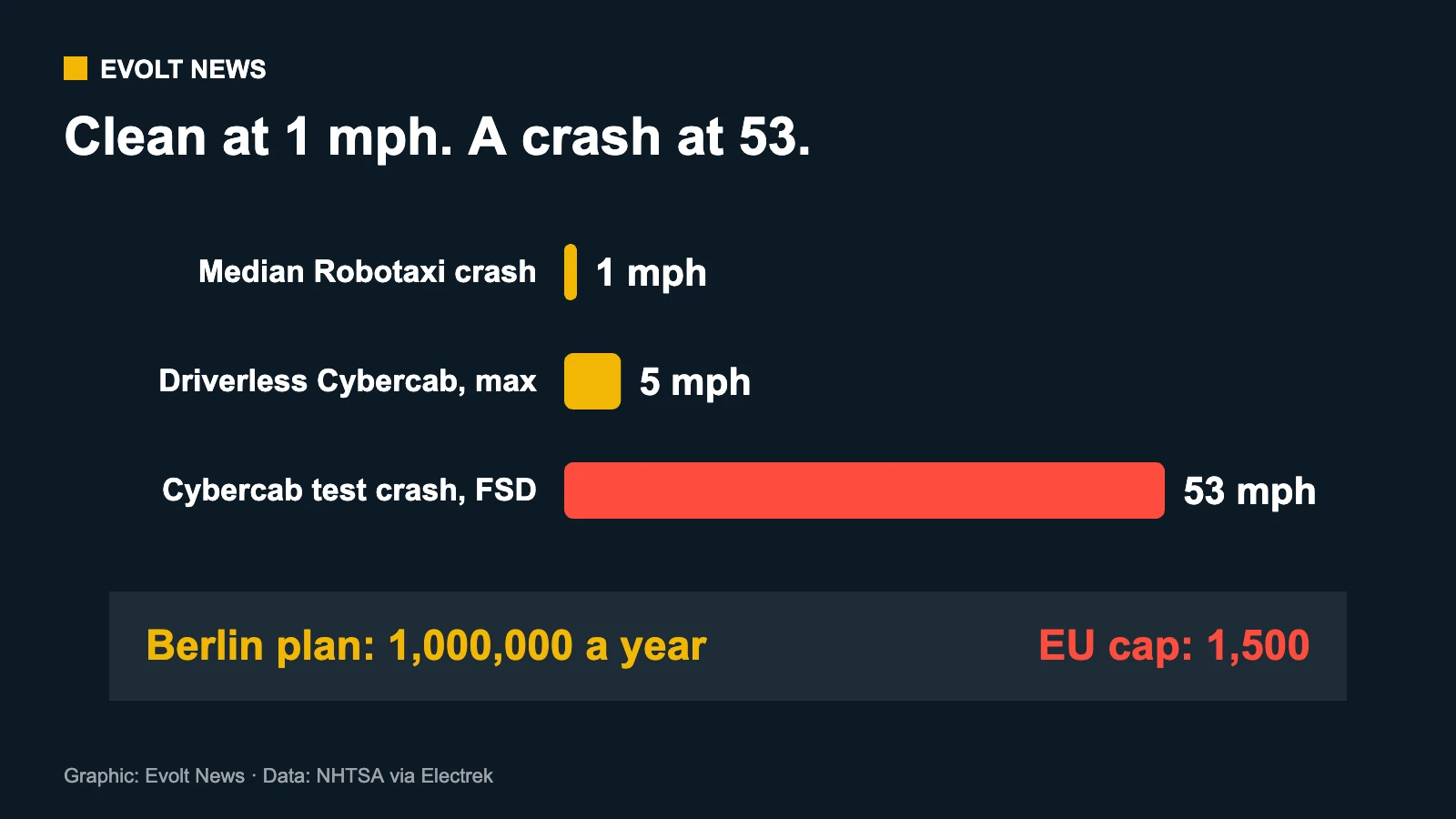
| Driverless, top speed | 4, all at 5 mph or less |
| With test driver and FSD, top speed | 4, up to 53 mph |
| Cybercab crashes with injuries | 2 |
| Median speed in all 43 Tesla Robotaxi crashes | 1 mph |
| Robotaxi crashes on a highway | 0 |
| Injuries in Tesla’s own safety report | 0 |
| Planned Berlin output, per year | up to 1,000,000 |
| EU limit for one driverless model, per year | 1,500 |
Zero injuries, if you don’t count
Tesla says zero people injured. Eight crashes, two with injuries, and Tesla says zero. How? Easy. You count only the miles that look good and leave the rest out. The test fleet with a driver? Doesn’t count. The miles with a safety monitor? Don’t count. It’s the same trick every time: show us the number that helps, hide the one that hurts.
Safe because it barely moves
Look at the median speed of Tesla’s Robotaxi crashes: one mile per hour. One. My grandmother walks faster. Not one crash on a highway, because Tesla doesn’t let it on a highway. Of course it looks safe. A car that sits in a parking lot all day is also very safe. But you can’t call it a taxi if it can’t take you to the airport.
53 mph and a black box again

And the one time a Cybercab drove at a real speed, on a Philadelphia highway at 53 mph, it crashed. What happened? We don’t know. Tesla blacked out the narrative, like it did with all four test crashes. The same week, I wrote about the Tesla that hit a truck at 71 mph and then sealed the file. It’s always the same: when the data could hurt, it becomes “confidential business information”. Just like Tesla’s secret Cybercab answers to safety regulators.
Testing where it has no permit
Tesla has no permit to run driverless cars in Pennsylvania or Utah. So it puts a person behind a steering wheel, switches on FSD, and calls it driver-assist. Legally, maybe fine. But don’t tell me this is a careful company. This is the company that, in my view, rushed the Cybercab to win a bet with a YouTuber. Move fast, break things, and hope the things aren’t people.
A million Cybercabs for a continent that allows 1,500
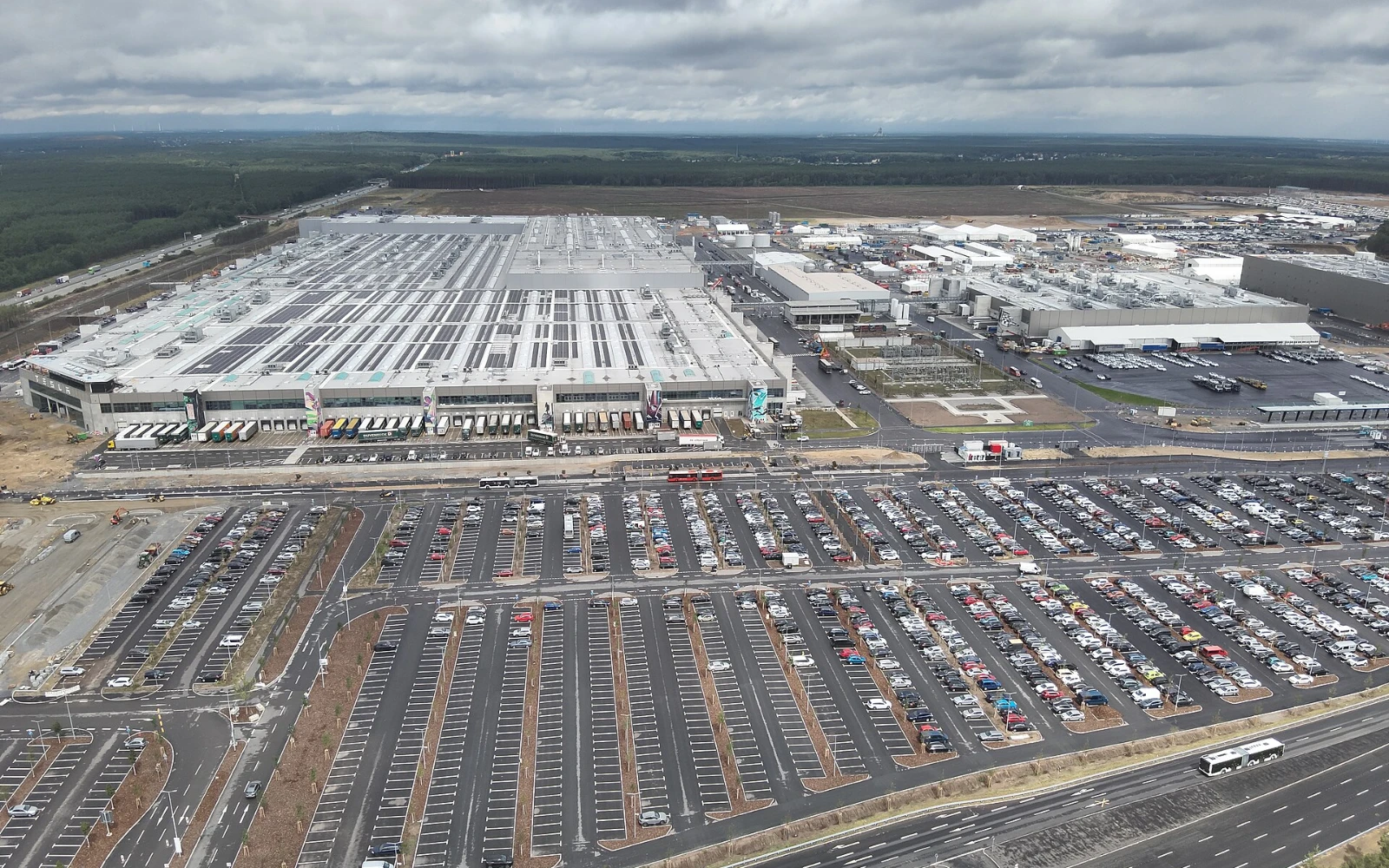
And then, the same day, the big show. A €3 billion factory in Berlin for a million Cybercabs a year. A million. In Europe, where right now one driverless model can get 1,500 registrations a year. In a plant that never reached the 500,000 cars Tesla promised when it opened. Please, I can’t believe what I’m writing myself. Tesla is a factory of promises, and now it’s building a factory for them too.
My prediction
By the end of 2027, no paying passenger rides a driverless Cybercab on a US highway. And Giga Berlin won’t build Cybercabs in 2029. Confidence: 75%.
Verdict
VERDICT: Safe at 1 mph, secret at 53. Tesla’s robotaxi record is clean only where the car crawls. Where it drives like a car, Tesla blacks out the file. Until that changes, a million-car factory is just another headline for investors.
Also on Evolt News: Tesla built a Cybercab to win a bet with a YouTuber · Tesla hides its Cybercab safety answers · Tesla on Autopilot hit a truck at 71 mph, then sealed the file
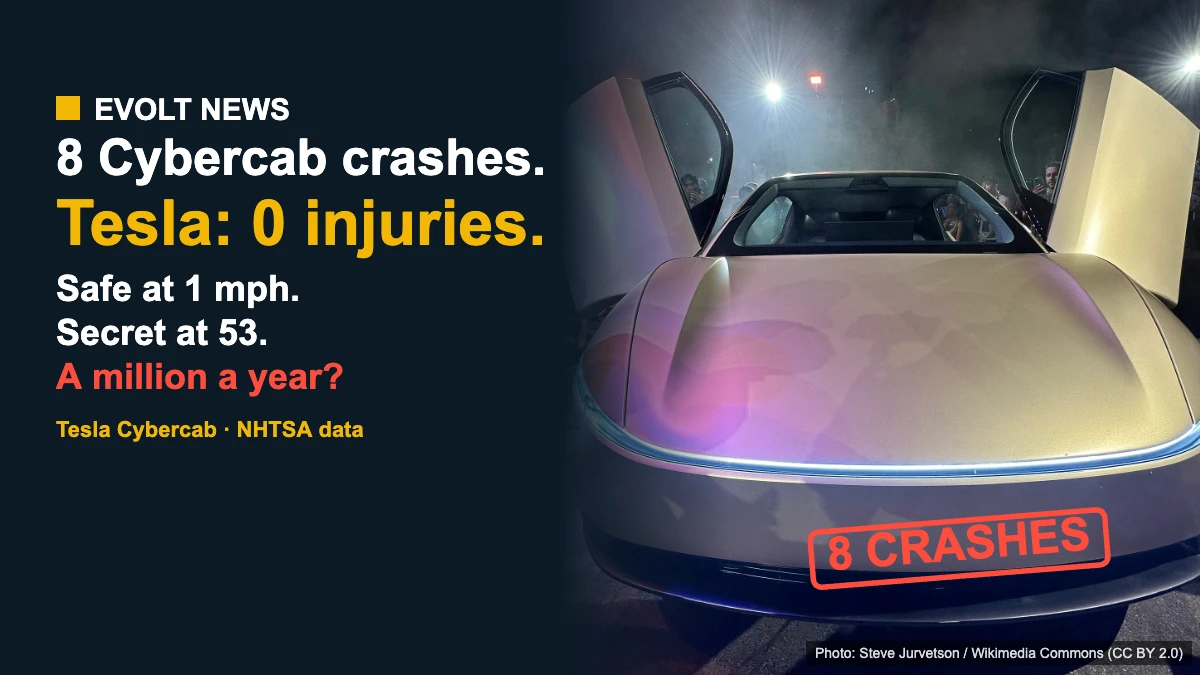
Featured image: the front of the Tesla Cybercab with its doors open. Photo: Steve Jurvetson / Wikimedia Commons (CC BY 2.0).
This article is opinion.
Update: Tesla then added 200 Cybercabs to the Texas register in a single day. Read Tesla registered 200 Cybercabs in one day. Registered isn’t driving.
Tesla Cybercab crashes: FAQ
How many times has the Tesla Cybercab crashed?
NHTSA data lists 8 Cybercab crashes: four in driverless Robotaxi service and four in testing with a driver and FSD engaged.
How fast were the crashes?
The four driverless crashes were all at 5 mph or less. One test crash happened at 53 mph on a highway in Philadelphia.
Were people injured?
Two of the eight Cybercab crashes involved injuries, both in the test fleet with a driver on board.
Does Tesla’s Robotaxi drive on highways?
No Tesla Robotaxi crash on record happened on a highway. The service runs mostly on low-speed routes inside small zones.
What did Tesla announce for Giga Berlin?
A €3 billion production hall for up to 1 million Cybercabs a year, with production planned for 2029.
Can Tesla sell driverless Cybercabs in Europe?
Under current EU rules, a driverless vehicle model is limited to 1,500 registrations a year.
Sources: NHTSA, Tesla, Electrek.
Our Take
The Cybercab’s driverless record looks clean because Tesla keeps it slow and off highways, while the crashes at real speed sit in a file Tesla blacked out.
On the same day, Tesla promised a million Cybercabs a year from Berlin. Before the factory, the car has to learn to drive fast without hiding the data.