Key takeaways
- NHTSA ordered Tesla to explain under oath how the Cybercab, with no steering wheel, brake pedal or mirrors, meets federal safety standards. Tesla answered on October 30 and asked to keep the whole response confidential.
- The only public document is a 30-page guide for firefighters. Paid Cybercab rides in Austin go on while NHTSA decides on the secrecy request.
- My view: safety rules for public roads are not a trade secret. If Tesla had a strong answer, Elon Musk would post it on X the same evening.
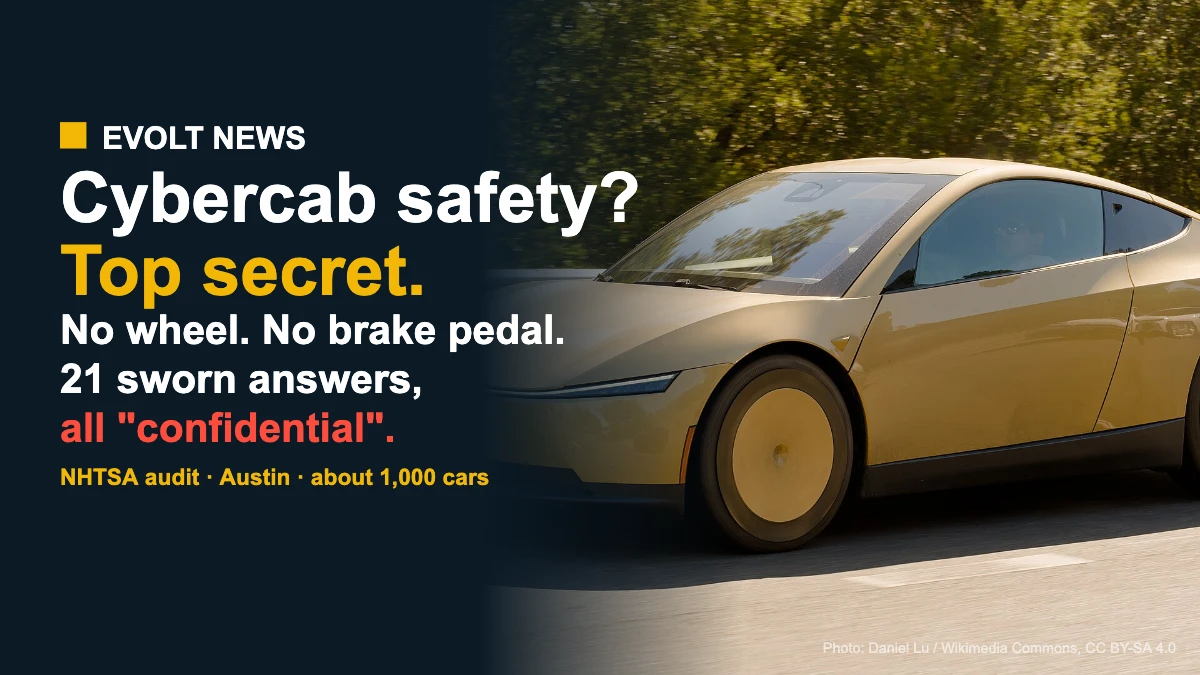
Tesla answered NHTSA’s 21 sworn questions on how the Cybercab, a car with no steering wheel, brake pedal or mirrors, meets federal safety standards, and asked that the entire response stay confidential. The only public part is a 30-page guide for firefighters, while about 1,000 vehicles fall under the audit and paid rides in Austin go on.
In this article: A manual for firefighters instead of an answer · Since when is safety a trade secret? · “Typically” is not a safety standard · The same game, again · NHTSA, say no · FAQ
A manual for firefighters instead of an answer
Let me get this straight. The regulator asks a simple question: how does a car with no brake pedal meet a rule that literally says the brakes must be operated by a foot control? And Tesla answers with a guide for firefighters and tow trucks. A guide it has had on its own website since July. The rest is one page with one sentence: “The entirety of this file is confidential business information.”
For God’s sake, would you get into a taxi if the driver refused to show you his license and handed you a fire extinguisher instead? Nobody would. But that is exactly what Tesla does here, and it keeps charging for every ride.
Since when is safety a trade secret?
I understand that a company hides its chips, its code, its suppliers. Fine, nobody is asking for that. The question is different: how did you check that this car is safe for the people inside and for everyone around it? That’s not a secret recipe. That’s the minimum you owe everyone who shares the road with you.
In my opinion, there are only two reasons to hide an answer like this. Either the answer is weak, or there is no real answer at all. If Tesla had something strong, Musk would post it on X with ten exclamation marks. When he has good news, we hear it before breakfast. When the news is about safety, suddenly everything is confidential.
“Typically” is not a safety standard
The one public document says the Cybercab is “not typically equipped” with a steering wheel or pedals. Typically. So sometimes it is? The same guide says a Cybercab with a wheel and pedals is “typically” an engineering or test vehicle. That little word is exactly what NHTSA asked about: did Tesla bolt the controls on for the tests and take them off afterwards? The answer: confidential.
Now look at the difference. Zoox, Amazon’s robotaxi, has no steering wheel either. It applied for an exemption, explained everything, waited about three years and got a cap of 2,500 cars a year. Its file is public. Tesla certified itself, started charging for rides on September 3, and now that someone asks how, it closes the door. Others wait in line. Tesla jumps the line and then asks the guard not to look.
The same game, again
This isn’t the first time. In June 2025, Tesla asked NHTSA to hide its answers about the first Robotaxi in Austin, and those answers never came out. After the Cybercab crash in Philadelphia, silence. Yesterday I wrote how Tesla sold FSD in Korea to cars that can’t legally use it. Now Austin. The pattern never changes: sell first, drive first, collect first, and the questions come later, if ever.
And the threat? A fine of up to $139 million for an incomplete answer. For a company worth more than a trillion dollars, that’s small change, and Tesla knows it.
NHTSA, say no
Now the decision is with the regulator. NHTSA can reject the secrecy request and publish the answers. I really want it to do that. Not for me, not for journalists, but for the person sitting in a car with no steering wheel, and for the pedestrian crossing in front of it.
My guess: if NHTSA stays quiet, we’ll learn the truth only when the first serious Cybercab crash lands in court. And by then it will be too late for someone. I don’t want to be a test subject for a company that won’t even show how it tested.
Also on Evolt News: Tesla Took FSD Money in Korea for Three Years. And the Court Blamed Korea? · Tesla Cybercab Crash Rips Off a Door Panel · Tesla Robotaxi Houston: A Rocket-Shaped Map · Tesla Was Ruled Liable for Fraud Over a Solar Roof. It Offered the Owner $5,000
Featured image: Daniel Lu / Wikimedia Commons (CC BY-SA 4.0).
This article is opinion.
Tesla Cybercab NHTSA audit: FAQ
What is the Tesla Cybercab?
A two-seat Tesla robotaxi with no steering wheel, pedals or mirrors, built at Gigafactory Texas. It has carried paying passengers in Austin since September 3, 2026.
What did NHTSA ask Tesla about the Cybercab?
A Special Order with 21 sworn questions on how Tesla certified the Cybercab to federal safety standards, including the foot-brake rule (FMVSS 135), mirrors and temporary driver controls.
What did Tesla make public?
Only its Cybercab First Responder Interaction Plan, a 30-page guide for police and firefighters. Everything else is under a confidentiality request.
Can NHTSA reject Tesla’s confidentiality request?
Yes. Under Part 512, NHTSA’s Chief Counsel decides whether the claim holds and can release a public version.
What penalties does Tesla face?
Up to about $139 million in civil penalties for an incomplete answer, and possible criminal exposure for a false one.
How is Zoox different from the Cybercab?
Zoox asked for a Part 555 exemption, waited about three years and got a cap of 2,500 vehicles a year. Its petition is public. Tesla self-certified the Cybercab without an exemption.
I read this news on Electrek.
Sources: Electrek, Drive Tesla, TeslaNorth, Teslarati, The Auto Wire.
Our Take
Safety rules for public roads are not a trade secret. A company that sells rides in a car with no brake pedal owes everyone a clear answer on how it passed the brake rule.
Tesla had time, lawyers and the whole world watching, and it gave us a manual for firefighters. If the answer were good, we would already know it. NHTSA should publish it.