Key takeaways
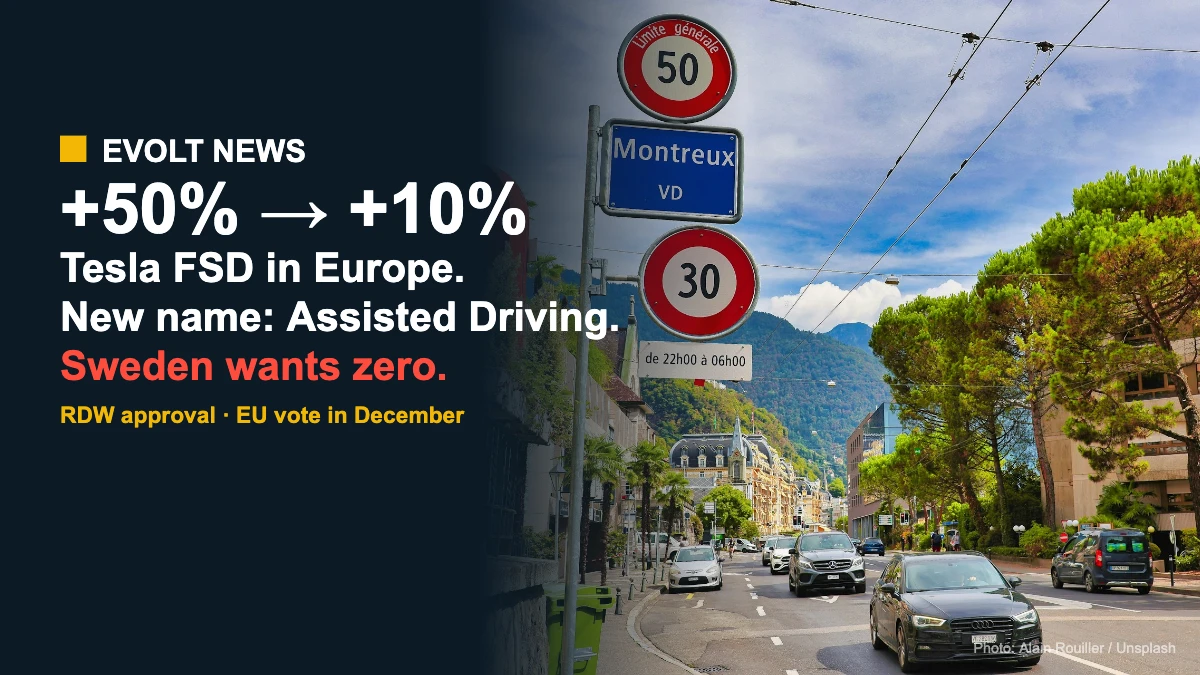
- The Dutch regulator RDW approved a Tesla update that cuts the FSD speed margin in Europe from +50% to +10% over the detected limit, resets it to 0% at every start, and renames “FSD Supervised” to “Tesla Assisted Driving.”
- Until now, a system approved in Europe could be set to drive 45 km/h in a 30 km/h zone. The changes match Germany’s conditions for backing EU-wide approval, with a vote in December at the earliest.
- My view: Sweden is 100% right with zero tolerance. The new name admits the old one was misleading, and people who paid for “Full Self-Driving” deserve money back.
On November 3, 2026, the Netherlands’ vehicle authority RDW confirmed it approved an update to Tesla’s driver-assistance system in Europe. The “speed margin,” which lets the system drive above the detected speed limit “for safety and traffic flow,” drops from up to +50% to a maximum of +10%: on a 100 km/h road, that is 110 instead of 150 km/h, and in a 30 km/h zone, 33 instead of 45 km/h. The margin now resets to 0% every time the car starts, and other speed-related functions are off by default.
The system is also renamed from “FSD Supervised” to “Tesla Assisted Driving” on the car’s display, in the owner’s manual and in other driver information on HW4 cars, delivered over the air. The RDW called these “several minor changes,” found no adverse effects and kept its April 10 approval unchanged; it stresses the driver remains fully responsible. The approval is recognized in 10 countries: the Netherlands, Belgium, Croatia, Czechia, Denmark, Estonia, Latvia, Lithuania, Slovakia and Slovenia. In October, Germany said it would support EU-wide approval if Tesla dropped the “misleading” Full Self-Driving name and capped speed tolerance at 10%; the EU vote has been pushed to December at the earliest and needs 15 of 27 countries representing 65% of the EU population. In the US, the same kind of software is still sold as “Full Self-Driving (Supervised)” for $99 a month.
| Speed limit | Old maximum (+50%) | New maximum (+10%) |
|---|---|---|
| 30 km/h city zone | 45 km/h | 33 km/h |
| 50 km/h city street | 75 km/h | 55 km/h |
| 100 km/h road | 150 km/h | 110 km/h |
| Setting at every start | Kept | Resets to 0% |
In this article: Who is to blame? Tesla, and even more the regulator · Sweden is 100% right · “Tesla Assisted Driving”: they finally admitted it · People who paid deserve their money back · A speed cap is useless if the car can’t read the sign · “Danke schön” was a calculated move · In a European city? Not even for gold · December: a half-baked compromise · FAQ
Who is to blame? Tesla, and even more the regulator
Who is to blame for this whole mess? The obscure duo of Tesla and the Dutch RDW, but in my opinion, the officials are a thousand times worse. Tesla, of course, likes to push its luck, so it happily sets a software tolerance of plus fifty, because Elon doesn’t give a damn about some European 30 zone. As long as it runs.
But the biggest disgrace is that the RDW is full of people who just rubber-stamped it without using their brains, and now they are playing dead. Where are we, that an American corporation can turn European roads into its own test track, and the regulators hold the umbrella for it? It’s sickening. And it’s the same RDW that, as leaked emails showed, Tesla pushed to scale back its review.
In Brussels, in a country that had already approved the system, a pedestrian safety group found it speeding in 55% of the 30 km/h segments it tested. That is what was already on European roads.
Sweden is 100% right
And their talk about speed? Sweden, with its zero tolerance, is one hundred percent right. Are road signs some optional recommendation? When the sign says 30, it’s because children are running around there, or the road is broken. So you drive 30, and that’s it.
What kind of idiotic algorithmic excuse is it that the system adds ten percent for “traffic flow”? I drive by the limits myself, because I don’t want to pay fines or hit anyone. So why should Tesla be allowed to get around the law? And when a speed camera catches the car, the fine goes to the driver, not to Tesla. Germany got its 10%. Sweden asked for zero, and in my view, zero is the only right number.
“Tesla Assisted Driving”: they finally admitted it
And that embarrassing renaming maneuver? Tesla Assisted Driving instead of the famous Full Self-Driving. After almost ten years, they finally showed their cards. In my view, it was misleading marketing aimed at people the whole time, and Germany’s Transport Ministry itself called the name misleading.
I already wrote about it when Tesla first agreed to the new name. Now it is official in the RDW approval. In America it still gets through, because the regulators there are as soft as Winnie the Pooh. But in Europe, Tesla hit a wall.
People who paid deserve their money back
And if anyone thinks the people who spent thousands on a “fully autonomous car” shouldn’t get money back, they’re crazy. To me, that’s ripping off customers. It’s like buying a ticket to a big sci-fi blockbuster and getting a broken slide show from the nineties.
A speed cap is useless if the car can’t read the sign
But the biggest point is what Electrek pointed out: Tesla’s biggest FSD problem is that it doesn’t properly detect speed limits. How can any speed cap help you when the car doesn’t reliably read the signs by itself?
Elon spent years saving on radar and precise maps, relying only on cameras, and as I wrote when Tesla admitted it now needs its own maps, it has caught up with him. It’s enough for a camera to miss a covered sign, the car decides it’s 80 there, and it drives on regardless. Without reliable reading of the limits, the whole FSD is just an expensive and dangerous toy on wheels.
“Danke schön” was a calculated move
And that famous “Danke schön” to Germany? That wasn’t politeness. It was a cold, calculated trick. Musk needed to show goodwill before the December EU vote to get approval at all.
Once the European bureaucrats sign off, I’d bet my shoes he will start pushing again through updates, testing what else he can get away with.
In a European city? Not even for gold
Would I use it in a European city? Not even if they paid me in gold. In those narrow streets, with cyclists everywhere, people crossing outside the crosswalks and a speed camera on every corner, I wouldn’t trust that system with my own socks. One stupid hesitation of the camera, and your driver’s license is gone.
December: a half-baked compromise
And the December EU vote? It will end like it always does. They will water it down, and it will pass by the skin of its teeth, because, in my view, German carmakers also want to push their own assistants through. But it will be a half-baked mess.
In short, this whole autonomous trend in Europe is, for now, one giant comedy, where people pay serious money to be guinea pigs for a company that talks about safety all the time.
Also on Evolt News: Tesla now needs its own maps for FSD · Musk vs Waymo · Tesla Robotaxi speeding in school zones
Featured image: Alain Rouiller / Unsplash.
This article is opinion.
Tesla FSD in Europe: FAQ
What changed in Tesla FSD in Europe?
The RDW approved an update that caps the speed margin at +10% over the detected limit instead of +50%, resets it to 0% at every start, turns other speed-related functions off by default and renames FSD Supervised to Tesla Assisted Driving on HW4 cars.
Is Tesla Assisted Driving the same as FSD Supervised?
Yes. The RDW says the name change does not change what the system does. It is still supervised driver assistance, and the driver remains responsible.
Where is Tesla Assisted Driving approved in Europe?
In the Netherlands and the nine countries that recognize the RDW approval: Belgium, Croatia, Czechia, Denmark, Estonia, Latvia, Lithuania, Slovakia and Slovenia.
When will the EU vote on Tesla FSD?
The EU Technical Committee on Motor Vehicles is expected to vote in December 2026 at the earliest. Approval needs 15 of 27 member states representing at least 65% of the EU population.
Why did Tesla rename FSD in Europe?
Germany’s Transport Ministry said the Full Self-Driving name was misleading and made a new name and a 10% speed cap conditions for supporting EU-wide approval. Tesla agreed in October.
Who pays a speeding fine when the system speeds?
The driver. The RDW stresses the system is driver assistance and the driver is fully responsible, so any fine goes to the driver, not to Tesla.
Sources: RDW, Electrek, Teslarati, Drive Tesla Canada, Not a Tesla App, TechRadar, New Mobility, Brussels Times.
Our Take
Tesla cut its European speed margin from +50% to +10% and renamed FSD to Tesla Assisted Driving. In my view, both the company and the regulator that rubber-stamped +50% should be ashamed, and Sweden is right that the only acceptable margin is zero.
The new name admits what the old one hid, and people who paid for “Full Self-Driving” deserve money back. As long as the car can’t reliably read the signs, I wouldn’t trust it in a European city, not even for gold.