Key takeaways
- Apple’s share of US smartphone shipments jumped from 50% to 57% in Q3 2026, while the whole market fell 9%. Apple was the only big brand that didn’t ship less.
- Memory now makes up 54% of the parts cost of a cheap phone, up from 20% a year ago. Motorola raised some Moto G prices by up to 50% and fell from 12% to 8%.
- My view: Apple didn’t win this round, the memory crisis won it for Apple. And a market where one company holds almost six of ten phones is not good news for your wallet.
Counterpoint Research says US smartphone shipments fell 9% in Q3 2026, but Apple’s share rose from 50% to 57%, Samsung’s from 24% to 25%, and Motorola’s dropped from 12% to 8%. In the same report, iPhone 18 Pro sales in their first three weeks were 4% lower than the iPhone 17 Pro’s.
In this article: A victory Apple didn’t fight for · The cheap phone is the real victim · 57% is not good news for you · The holiday quarter will show the truth · FAQ
Update: the normal iPhone 18 waits in line while the Pro and Duo go first
Apple “wins” China’s Singles’ Day by losing less
A victory Apple didn’t fight for
Read the numbers carefully. The iPhone 18 Pro sells worse than the 17 Pro did. So people aren’t running to Apple because it built something amazing. They run because the cheap alternative suddenly isn’t cheap.
When memory goes from 20% to 54% of the parts in a $200 phone, the maker has two choices: raise the price or stop selling. Motorola raised prices by up to 50% and lost a third of its share. Apple, with its huge margins, just swallowed it.
The cheap phone is the real victim
Think of a small bakery and a supermarket chain when flour doubles in price. The chain survives, the bakery closes. Nobody says the chain bakes better bread.
That is exactly what happened here. Students, older people, people who just need a phone for calls and WhatsApp were the buyers of a $150 Moto G. Now they either pay much more or keep their old phone. Some of them end up with a used or older iPhone, and Apple counts it as a win.
| Brand | Q3 2025 | Q3 2026 |
|---|---|---|
| Apple | 50% | 57% |
| Samsung | 24% | 25% |
| Motorola | 12% | 8% |
57% is not good news for you
I’ve said it before about Apple’s storage prices: with the memory crisis as an excuse, Apple keeps raising prices where memory barely matters. Now imagine Apple with almost 60% of the market and weaker rivals behind it. Who will stop the next price jump?
Competition is the only thing that keeps prices honest. When the cheap end of the market dies, the expensive end has no reason to calm down.
The holiday quarter will show the truth
Counterpoint itself warns that memory prices stay high through the end of the year, carriers give fewer discounts and people delay purchases. Sales at the three biggest US carriers already fell 4%.
My prediction: Apple’s share stays high, but the number of iPhones sold won’t. A bigger slice of a smaller cake is still a smaller cake. And the 4% drop of the iPhone 18 Pro is the number Apple should worry about, not the 57%.
Also on Evolt News: iPhone hits record share as the memory crisis begins · Latin America smartphone shipments drop 24% · iPhone 18 Pro sales drop in China, the US and Japan
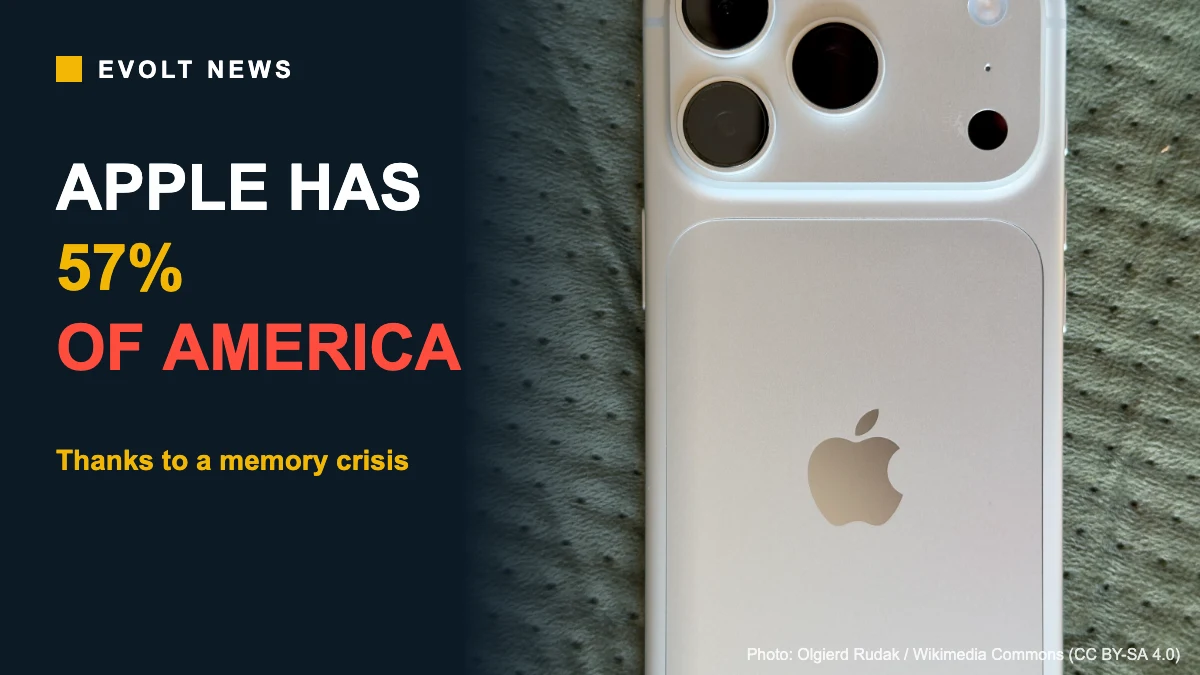
Featured image: Olgierd Rudak / Wikimedia Commons (CC BY-SA 4.0).
This article is opinion.
Apple 57% US market share: FAQ
What is Apple’s US smartphone market share?
57% of shipments in Q3 2026, up from 50% a year earlier, according to Counterpoint Research.
Did the US smartphone market grow?
No, shipments fell 9% year over year.
Why did Android brands lose share?
Rising memory costs hit cheap phones hardest; memory is now 54% of a low-end phone’s component costs.
How is the iPhone 18 Pro selling?
Its first three weeks of US sales were 4% below the iPhone 17 Pro’s, per Counterpoint.
Will prices drop for the holidays?
Counterpoint expects memory prices and retail prices to stay high, with more selective carrier discounts.
Sources: Counterpoint Research, Notebookcheck, Benzinga.
Our Take
Apple’s 57% looks like a triumph, but it was handed over by a memory crisis that is killing cheap Android phones, not earned by a better iPhone.
For buyers, a market with one giant and fewer cheap alternatives means fewer reasons for prices to come down.