Key takeaways
- Apple’s redesigned MacBook Pro, possibly called MacBook Ultra, is rumoured to bring an OLED display, a touchscreen and a Dynamic Island instead of the notch.
- Launch is expected as early as October, but reports leave room for a slip into early 2027. Apple has confirmed nothing.
- Bloomberg expects the new models to cost a few hundred dollars more than today’s MacBook Pro.
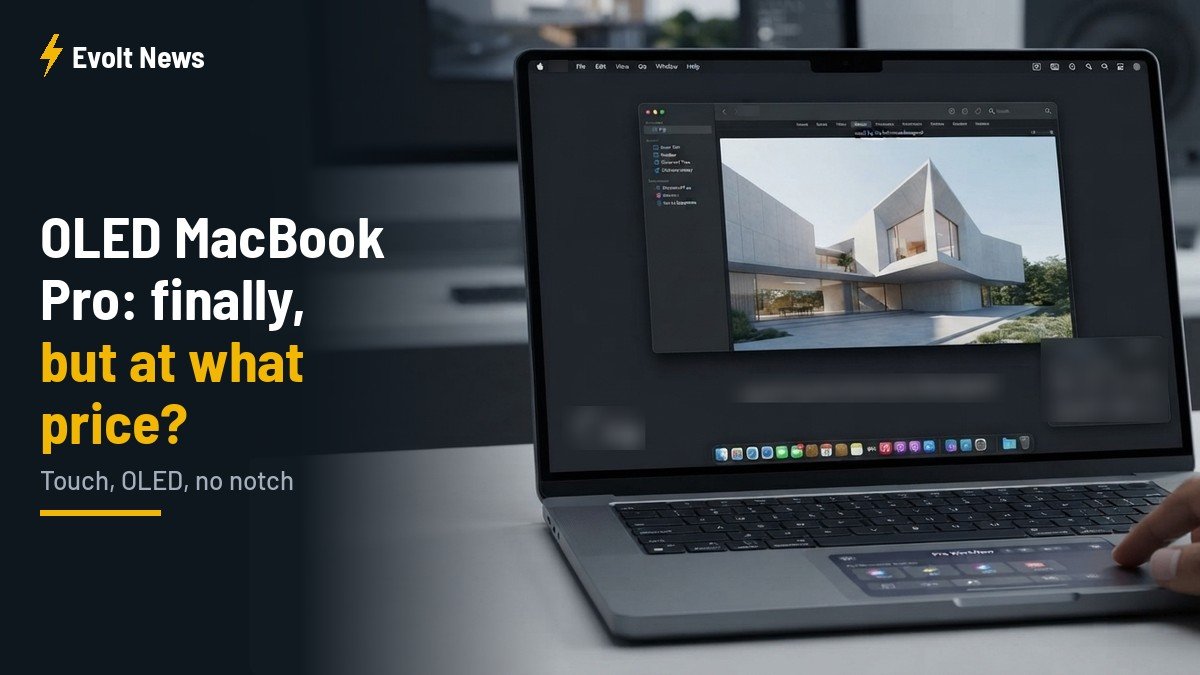
An OLED MacBook Pro is finally on the way, according to a steady stream of reports from Bloomberg’s Mark Gurman and other well-connected sources. The redesigned laptop is also expected to be the first Mac with a touchscreen and the first to drop the notch in favour of a smaller camera cutout with Apple’s Dynamic Island.
We use a MacBook Pro for work every day, and we are genuinely excited. But we also cannot ignore a question that keeps coming back: why did it take Apple so long to do something its competitors have been doing for years?
In this article: What to expect · OLED: late, but welcome · A touchscreen Mac · Goodbye, notch · The price question · Buy now or wait? · FAQ
What to expect from the redesigned MacBook Pro
Reports describe 14-inch and 16-inch models with a thinner design, OLED screens with touch support and a hole-punch camera. The launch is widely expected in October, which would also mark 20 years of the MacBook Pro, though some reports say a global memory chip shortage could push it into early 2027. The name is not settled either: “MacBook Ultra” has been mentioned as a possible new top tier.
For us, the part we would most like to see improved is not in the rumours at all: multitasking. The MacBook Pro is already a monster for work, and ours does everything we need. What we love most about the Mac is how it works together with the iPhone and iPad, letting you start something on one device and simply carry on on another. Nobody does that better than Apple. If the redesign makes juggling many windows and apps even smoother, that would matter more to us than any single spec.
OLED: late, but welcome
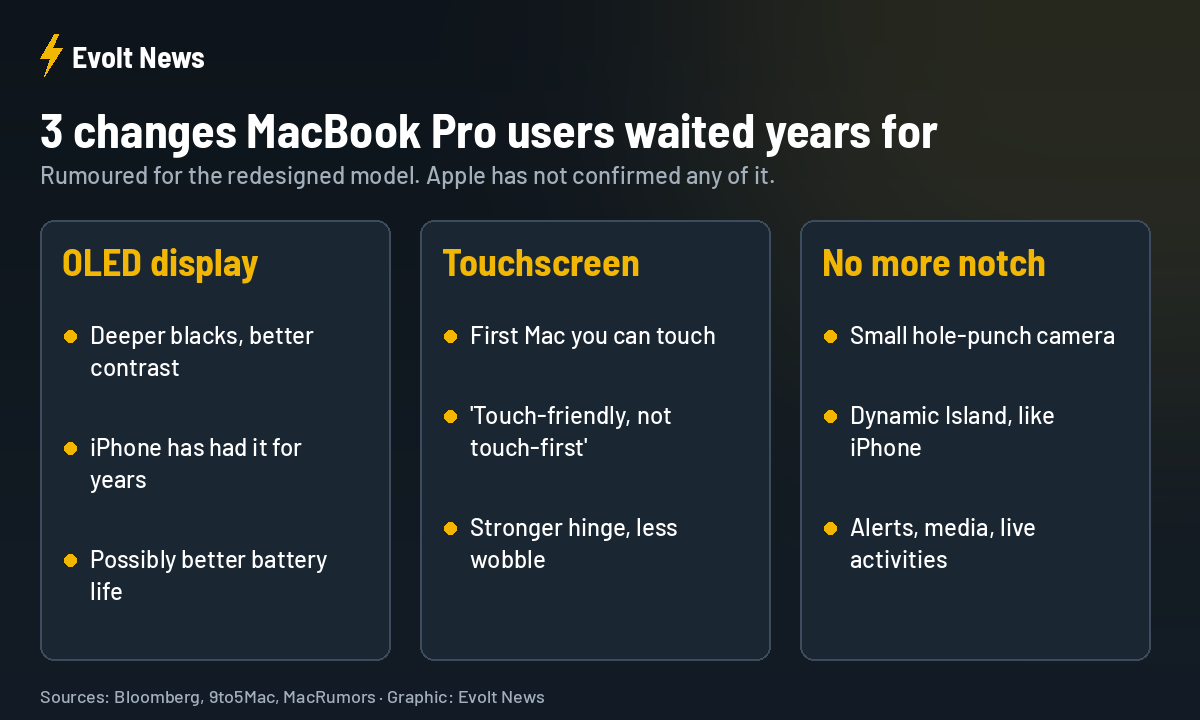
OLED brings deeper blacks, stronger contrast and richer colour, and it may help battery life too. We notice the difference every time we look at an OLED phone, and personally we simply prefer it. It makes everything you do on the screen more enjoyable.
That is exactly why the delay is so frustrating. The iPhone has used OLED for years, the iPad Pro got a tandem OLED panel in 2024, and competitors have been shipping OLED laptops for a long time. OLED is not a new feature. Our fear is that Apple will present it on stage as a breakthrough, as if it were doing it for the first time. Honestly, that kind of marketing is hard to watch.
And yet, we know how this usually ends. When Apple finally does something, it tends to do it at the highest level, and it often becomes the one to beat. We do not want to be the people who complain today and then happily buy it tomorrow, so we will judge it when we see it.
A touchscreen Mac: Apple changes its mind again
We have tried convertible laptops from Lenovo and other brands, and touch on a laptop is genuinely handy. After years of using phones and tablets, you often reach for the screen automatically. So yes, it makes sense to us.
According to Gurman, the Mac will be “touch-friendly, not touch-first”. The keyboard and trackpad stay central, the interface adapts between touch and pointer, and Apple is reportedly adding a stronger hinge so the screen does not wobble when you tap it.
It is also a very Apple story. For years the company said a Mac does not need a touchscreen. It said something similar about foldable phones while Samsung and Huawei sold them for years, and then came the iPhone Duo. Apple rejects an idea, waits, and eventually adopts it. The good news is that when Apple adds something, it usually works differently from everyone else, and people start using it in ways that feel natural. We are curious to see how it works in practice.
Goodbye, notch
The notch arrived with the 2021 MacBook Pro redesign. Reports say it will be replaced by a small hole-punch camera with a Mac version of the Dynamic Island, showing alerts, media controls and live activities. Current Macs still use Touch ID rather than Face ID, and Face ID on the Mac is reportedly still years away.
We like the direction. Every step makes the camera cutout smaller. What we are really waiting for is a camera hidden completely under the display, leaving a nearly borderless screen with nothing in the way. That day will come, just not yet.
The price question
Bloomberg expects the new models to cost a few hundred dollars more than current versions. Our own guess is around $500 more, because the touchscreen and OLED panel will be used to justify a higher price. We are fairly certain it will be more expensive, since prices across Apple’s products keep climbing. Whether it is worth it, we will only know once it is on sale.
We also have a view on the name. “Ultra” feels like marketing to us. We would rather Apple kept “Pro”, which has always meant the best segment, and reserved touch for the Pro models, so buyers can clearly tell them apart from the Air and the cheaper MacBooks.
Buy now or wait?

Our honest advice to most readers: wait for the second or even third generation. First models with brand-new features usually have the most bugs and lag, and a touchscreen Mac is a big change for both hardware and software.
We will admit, though, that we will probably buy the first one anyway. We are Apple fans. We can criticise the company, and we do, but in the end its products are still the ones we trust most.
OLED MacBook Pro FAQ
When will the OLED MacBook Pro be released?
Reports point to October 2026, but a delay into early 2027 is possible. Apple has not announced a date.
Will the new MacBook Pro have a touchscreen?
Yes, according to multiple reports. It is expected to be touch-friendly, while keyboard and trackpad remain the main way to use macOS.
Will it be more expensive?
Very likely. Bloomberg expects a price a few hundred dollars higher than current models.
Will it have Face ID?
Not at first, according to reports. The notch is expected to become a smaller hole-punch camera with a Dynamic Island.
Sources: Bloomberg (Mark Gurman), 9to5Mac, MacRumors, Macworld, TechRadar, The Apple Post.